A reply list can help an operator find conversations that deserve attention. The difficult part is deciding what the label actually describes. Is it the first answer, the latest exchange, a particular campaign or the most recent classification somewhere in the workspace? Those are different objects, even when the same person appears in each view.
This guide is for someone evaluating classification-assisted campaign triage. Its useful output is a decision record connecting the actual message, its context, a responsible person and a next action. It does not compare classifier accuracy or teach a campaign cadence. The cases are original fictional examples; no account, classifier, message or queue was operated.
Start with the product’s actual contract
HeyReach’s Auto-Tag documentation, read 7 November 2026, describes campaign replies, a 15-minute delay after the first reply, and no retagging from later replies in that conversation. A newer campaign-generated tag can replace the workspace-wide label. Tag details identify its originating campaign and sender. These are vendor instructions, not our runtime test or a rule for other products.
The buying implication is to ask what evidence remains available beside a classification. A label without a recoverable origin makes it harder to distinguish a historical observation from the current conversation. Do not assume that a similarly named feature in another tool uses the same timing, scope or update rules.
Case 1: the conversation changes before classification
All three cases are fictional. Names, campaigns, dates, messages and proposed actions are invented. Times use Europe/Paris. No tag value is assigned to any example message, and none predicts what a classifier would produce.
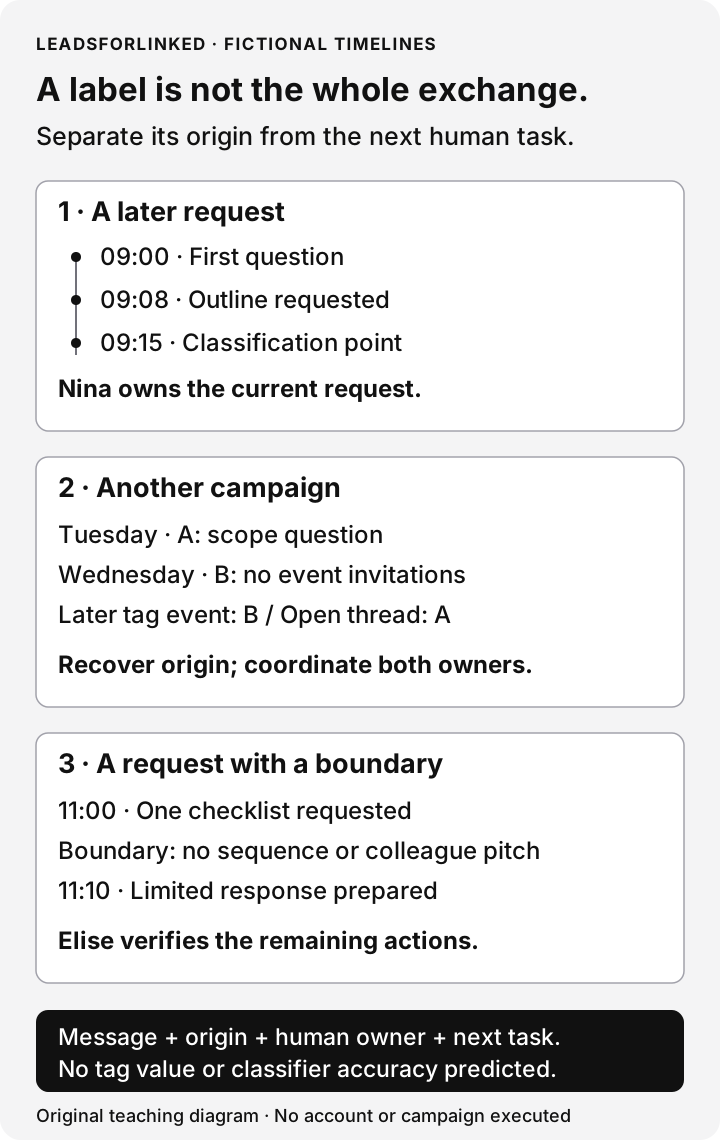
Nina handles replies for a consultancy offering a review of how branch stock figures reach purchasing. Campaign A uses Nina’s sender account. The offer concerns the handover process and its documentation, not dashboard development. The recipient, Maya, asks which part of the business the proposal concerns.
- Monday 09:00 — first reply. Maya writes: “Which part of our operation are you asking about?” Nina’s next task is to clarify the subject. There is no agreement to a meeting or purchase.
- 09:04 — scope answer prepared. Nina drafts: “The handover of branch stock figures to purchasing. I review that process and document the agreed steps; I don’t build the reporting system.” This is proposed wording, not a recorded send.
- 09:08 — a more specific request arrives. Maya adds: “Purchasing owns that. Could you send the outline of what your review covers?” The latest task is now to provide an accurate outline, not repeat the ownership question.
- 09:15 — the documented delay reaches its endpoint. A resulting label would concern the first reply, not automatically summarize the later request. The example leaves its value unspecified.
Completed decision: Nina owns the requested outline. She checks it against the actual service boundary and prepares a personal answer. Any generic pitch already planned needs separate review. She does not wait for a label before recognizing the question, and she does not describe the exchange as a booked project.
Her proposed working note is: “Campaign A, Nina’s sender. Maya requested the service outline at 09:08. Nina to provide the approved scope. Remaining follow-up verification open.” The note records the human task and the unresolved control; it is not a claimed built-in tag field or a completed cancellation.
If the approved outline is unavailable, Nina holds the answer and obtains it. If another colleague has already responded, she reads that response before adding hers. The correction is to restore the missing context and ownership, rather than send a polished version of a question Maya has already answered.
Case 2: a different campaign supplies the current label
Another fictional workspace contains two approaches to the same person, Rowan. Campaign A concerns an operational handover review, with Lena as sender. Campaign B concerns an event invitation, with Owen as sender. The duplication already exists in this scenario; it is a problem to reconcile, not a recommended way to run parallel outreach.
- Tuesday 10:00 — first reply in Campaign A. Rowan asks Lena: “Does the review include changing the purchasing system?” That requires a scope answer from Lena. A tag event associated with A is subsequently recorded in the fictional timeline; its classification value is not specified.
- Wednesday 14:00 — first reply in Campaign B. Rowan tells Owen: “Please don’t send me event invitations.” Owen must respect that instruction. It does not establish Rowan’s current view of the different service in A.
- 14:15 — a later tag event is associated with B. Under the documented workspace rule, that newer event can replace the label seen while A is open. It does not rewrite A’s earlier message.
- 14:20 — Lena reviews A. She must reconcile the current label’s origin with the scope question still in A, rather than answer as though the label were Rowan’s latest statement about her service.
Completed decision: Owen owns the invitation stop request. Lena owns the outstanding scope question, subject to reviewing the full contact context with Owen before any further message. They check other planned outreach so neither colleague becomes a way around a request. If the request’s intended scope is unclear, they hold a further pitch rather than presume permission from A’s earlier activity.
The proposed record keeps two separate facts: “A: system-change question remains unanswered; Lena responsible” and “B: no more event invitations requested; Owen responsible for verification.” It also records that the displayed tag event originated in B. It does not call Rowan interested in both campaigns or mark both conversations closed from a single workspace label.
If the origin cannot be recovered, preserve the uncertainty. Use the actual threads and available activity evidence to reconstruct it; do not guess the campaign from whichever screen happens to be open. A person may appear once in a workspace list while still having several distinct questions or restrictions in their history.
This also changes reporting. A present-day label is not, by itself, evidence of the response category a campaign had at an earlier cutoff. Retain the relevant original observations if you need a historical comparison. The reply-diagnosis guide owns the separate job of interpreting response categories and audience fit; it does not convert today’s label into a past campaign result.
Case 3: interest arrives with a clear boundary
Elise receives a fictional reply to a campaign about a reporting-handover checklist:
The checklist could be useful. Please send it here once, but don’t add me to another outreach sequence or contact our colleagues.
There are two instructions to retain: a specific request for the checklist, and a boundary on subsequent outreach. Reducing the message to either “interested” or “not interested” in a human working note would lose useful meaning. This case supplies no system-generated classification and makes no claim that a particular classifier would miss the boundary.
- Thursday 11:00 — reply received. Elise reads the whole message, including the restriction. She does not broaden a request for one resource into agreement to a sequence, a meeting or colleague outreach.
- 11:05 — ownership established. Elise owns the requested response and the check of remaining work. She identifies the approved checklist and the accounts or colleagues involved in the current approach.
- 11:10 — response prepared. Proposed wording: “Understood. I’ll keep this to the checklist you asked for and check the remaining outreach.” The wording does not claim that a queue has already been cleared.
- Before further action — controls reconciled. Elise verifies the appropriate remaining actions and retains the person’s boundary in the working process. Unresolved removal stays unresolved; it is not marked complete merely because a note was saved.
Completed decision: prepare only the requested, accurate resource response and prevent a new pitch under this case’s working policy. Do not move the person to another campaign or substitute a colleague. If the resource is not approved or available, resolve that gap instead of inventing a download or promising content that does not exist.
The record can say: “One checklist requested here. No new sequence or colleague approach. Elise owns the reply; remaining-action verification open.” This is an authored record format, not a claimed product export or enforcement feature. The follow-up guide covers the next-message decision once the actual request is understood.
Turn the cases into a buying acceptance check
Ask a supplier to demonstrate the chain you need: a classification can be traced to its source exchange; the current conversation can be read; the responsible operator can record a decision; and outstanding campaign work can be inspected. These are buyer requirements, not assertions that every platform exposes the same fields or controls.
Origin: can the operator establish the relevant campaign, sender, conversation and event time? If access is restricted or an original account has been removed, ask what remains recoverable. Hold origin-dependent reporting when the necessary evidence is missing.
Current meaning: can the operator see later messages and preserve a question or restriction that a short label cannot express? Ask where a human correction or note belongs, whether it changes the classification, and what other users will see. Do not treat note-taking as proof of a model override.
Authority: identify who may answer, change a sequence and verify its resulting state. A user who can read a conversation may lack the needed control. If responsibility changes, transfer the actual question and boundary with the task, not only the label.
Recovery: when a current view conflicts with the thread, read the messages first, recover the origin and correct the next action. Keep the original event for any historical analysis. Do not launch a fresh campaign to manufacture a cleaner-looking state.
Choose a workspace for the human job that remains
If your present sender already supports the required review and follow-through, keep it. The cases identify work to own; they do not establish a reason to replace a tool or buy an AI classifier. The AI SDR buying guide covers the broader sourcing, drafting and human-authority decision.
For a one-account campaign and personal-reply workflow, compare the normal Leadsforlinked platform offer and Inbox workflow. The published Starter offer is EUR 29 per month on monthly billing for one connected LinkedIn account, with campaigns, follow-ups, Inbox, Kanban and analytics. AI Responder belongs to Diamond Pro. None of these catalogue statements establishes automatic reply tags, equivalent provenance, editable classifications or automatic cancellation in Leadsforlinked.
No profile collection is needed to interpret the existing replies in these examples. If a separate job lacks profile input, the free profile route offers 100 profile leads once at signup, in batches of 20, with no card, for audience and CSV review. It is distinct from the paid conversation workspace.
Evidence scope · 7 November 2026. The linked HeyReach page describes a vendor mechanism, with relative update wording rather than an exact publication date. The timelines, proposed notes and decisions are original teaching material. No classifier result, accuracy rate, customer outcome, product execution or checkout is presented.
Need campaigns and personal reply handling?
Compare the normal Starter workflow with the context, ownership and controls your current process needs.
Review the campaign and Inbox workflow