A low reply percentage tells you that few recorded recipients replied within the window you counted. It does not explain why. The wrong person may have received a clear offer. The right person may have no current need. An interested person may be asking what you actually do. Silence leaves those possibilities unresolved.
Start with the conversation record, the reason each person was selected and the service you proposed. Preserve the original counts before changing a message or buying another audience. This guide uses a fictional stock-reporting service to show how the same overall metric can conceal very different commercial questions. It supplies no industry benchmark or promised improvement.
Ask four questions before changing anything
1. Does this person own the relevant work?
A title is a starting hypothesis about responsibility. A branch operations manager might coordinate figures, while finance decides which figures purchasing should use. A response such as “that sits with finance” is evidence to revisit the selection rule. It does not establish that a named colleague wants contact, and it does not prove every silent person has the same role mismatch.
2. Is there a current need?
Someone can own the process and be satisfied with it. A company announcement or an event appearance supplies context, not a confirmed problem or purchase timetable. If the person says the handover is already clear, retain that answer rather than manufacture an objection to overcome. If they describe an unresolved issue, ask enough to understand it before proposing work.
3. Can the person tell what the offer includes?
“We improve reporting” could mean software development, data cleanup, dashboard design or a process review. A question about the boundary may call for a direct explanation. It is neither a refusal nor agreement to buy. Several similar questions are a reason to inspect the offer wording, not proof that one rewritten sentence will lift replies.
4. Is the useful exchange being handled?
A relevant question left unanswered is a follow-through problem. So is a prepared generic message that no longer fits a new reply. Identify the person responsible and check the remaining actions. The follow-up decision guide covers choosing the next action from the actual conversation; this diagnostic helps decide what needs correcting first.
Worked example: more replies, the same relevant interest
Fictional exercise. All people, messages and counts below are invented for teaching. No LinkedIn search, export, send or product execution took place. The offer is a stock-reporting handover review for small distributors: map how branch figures are checked and passed to purchasing, then document the agreed process and unresolved issues. It does not include building a dashboard or changing an ERP.
The consultant compares two disjoint groups of 40 unique recipients. Group S came from a company People-search list filtered for an assumed responsibility. Group E came from an industry event participant list. Neither source is treated as proof of role or need. For this exercise, each recipient has one recorded initial outreach attempt, with a complete seven-day observation window after it. Seven days is a counting assumption here, not recommended timing for a follow-up.
The consultant counts each person once, using their first human reply in that window. Automated acknowledgements do not qualify. If a reply contains a stop request, it belongs in refusal/stop; otherwise, the consultant reads the meaning and assigns one of the remaining categories. Ambiguous replies stay unresolved until reviewed, rather than being silently counted as interest. This particular dataset has no unresolved classifications.
The arithmetic is descriptive: S has 14 ÷ 40 = 35% human respondents; E has 18 ÷ 40 = 45%. E is higher by 10 percentage points. Yet relevant-interest first replies are 2 ÷ 40 = 5% in each group. Relevant interest here means a suitable discussion is possible; it is not a booked meeting, qualified sale or revenue.
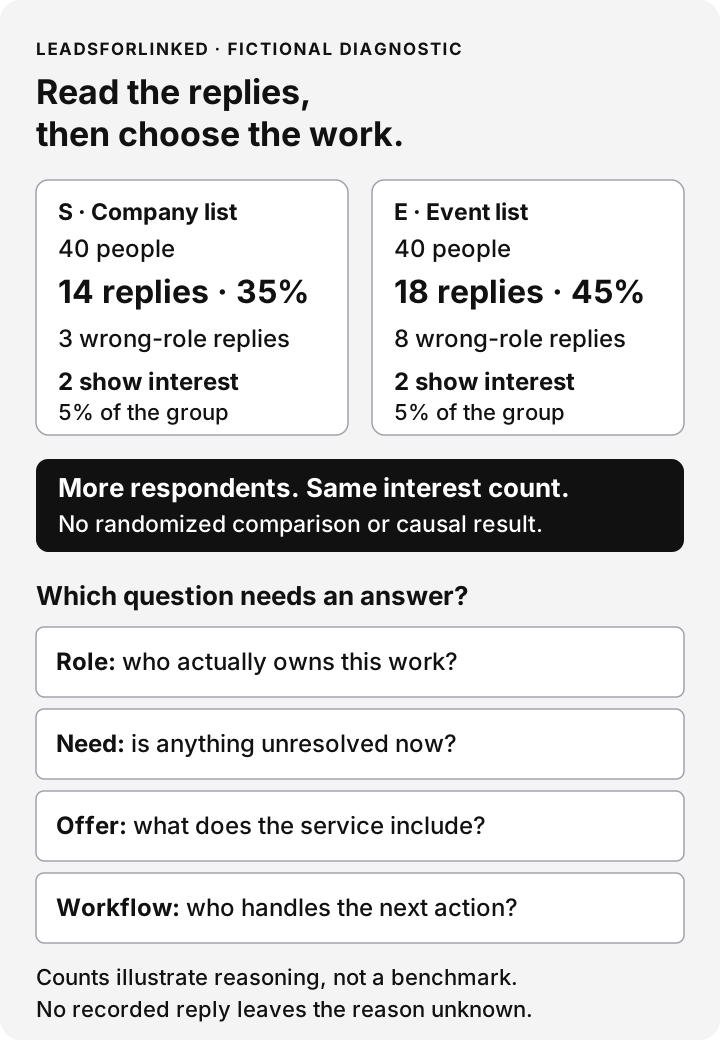
Calling E the commercial winner from the aggregate would hide its eight wrong-role answers. They suggest checking whether the event list’s selection rule matches this service. They do not establish that the source caused the difference: the groups were not randomized, and their people may differ in other ways. Keep the source labels as provenance, not a ranking of “warm” and “cold” people.
The seven scope questions across both groups also deserve review. Read their actual wording: if they ask whether the consultant builds dashboards, clarify that boundary. The six no-current-need replies may reflect an adequate existing process. The four refusals end those approaches. The 48 people with no recorded human reply have unknown reasons; an outreach attempt does not prove delivery or reading.
Freeze this first-reply table as the original observation. If a scope question later becomes a relevant discussion, record that development in the conversation history with its own date. Do not rewrite the initial classification and then present the revised figure as the original result. Keep the denominator of 40 per group, including refusals and silence.
Correct the question you are asking
The consultant’s original fictional opening is too broad to distinguish these problems:
We help distributors unlock operational efficiency with smarter data. Open to a call?
The recipient cannot tell whether this means a new system, reporting advice or process work. A revised opening can use a real, checked piece of context to test responsibility. In this fictional alternative, the company has publicly announced bringing two branches onto one stock report:
Hi Maya — your team’s update mentions bringing two branches onto one stock report. Are you responsible for agreeing which figures purchasing uses, or does that sit with finance?
This asks who owns a defined decision. It does not claim that the project is failing or that Maya wants consulting. If the update is absent or does not say this, the opening is unusable. Do not substitute a guessed detail simply to preserve the template.
Suppose Maya asks, “Do you build the dashboard?” Answer the scope question before asking for a meeting:
No. I review how branch figures are checked and handed over, then document the agreed changes. I don’t build dashboards or change the ERP. Before suggesting work, I’d want to understand whether that handover is already clear.
If Maya says finance owns it, correct the responsibility hypothesis. If she says it works well, accept that the offer may have no current job. If she describes conflicting figures, understand which decision they affect before proposing a review. If she declines, end the approach. These are alternative outcomes, not steps that every recipient should receive.
The new wording is a proposal to evaluate, not a measured improvement. There is no universal word limit or required number of touches in this guide. Keep enough context to make the question understandable and the service boundary accurate. If you later want to compare two openings, use the A/B testing guide for a defined comparison rather than treating these two different source groups as a copy experiment.
Buy the missing capability only after the diagnosis
Write a short decision before choosing software: “Review the eight event-list role mismatches; answer the seven scope questions individually; preserve the four refusals; relevant conversations remain with the consultant.” That is a proposed action record for this invented case, not proof that anything has been sent or cancelled.
If role fit is uncertain, check the current responsibilities and the selection rule before collecting more. When the missing input is a defined sample of profiles, Leadsforlinked’s published free offer provides 100 profile leads once at signup, in batches of 20, with no card, for audience and CSV review. The profile extraction guide explains that input route. It does not establish a need among those people or include a free campaign workspace.
If the offer is unclear, clarify the service boundary and answer the person’s question. More profiles or an AI-written reply cannot decide whether dashboard development belongs in a process-review offer. If the current process already works, keeping the existing tools and declining to propose unnecessary work is a valid outcome.
If repeated campaign and reply handling is the missing job, compare the Leadsforlinked outreach platform and normal Starter offer with your current process. The published Starter offer is €29 per month on monthly billing for one connected LinkedIn account, with multi-step campaigns, follow-ups, Inbox, Kanban and analytics. It fits a workflow where you write the response and decide the next action. AI Responder belongs to the separate Diamond Pro offer.
Those are catalogue statements, not a test of your account or its execution. Verify the required controls and current entitlement before relying on them. A personal answer or a changed pipeline label does not prove another scheduled action was removed. The campaign handoff guide and Inbox guide cover those product-side boundaries. A clear manual process may remain adequate for a few exchanges; this example alone does not justify a subscription.
Frequently asked questions
Is a higher LinkedIn reply percentage always better?
No. Define what was counted and read the responses. In this fictional example, one source has more respondents but the same number of relevant-interest first replies. Wrong-role answers, refusals and questions require different decisions; none is a sale.
Does an event appearance prove current need?
No. It gives context for research. Verify the person’s responsibility and let the conversation establish whether the offer has a current job. Do not infer a buying timetable from the source label.
Should I remove refusals from the reply-rate calculation?
Keep them in the original recipient denominator and classify them honestly. They are human replies, while also ending the current approach. Removing them to improve the figures loses the meaning of the observation.
Will Starter or AI fix weak replies?
Tools can support a defined campaign and reply workflow. They do not prove role fit, create a current need or settle the service boundary. Starter includes the published campaign and Inbox workflow; AI Responder is a separate Diamond Pro feature.
Sources and scope
The four-question diagnostic and all worked counts and messages are original teaching examples, not a customer study or a tested performance claim. LinkedIn’s discovery-call guide distinguishes investigating needs and fit; Salesforce’s customer-centric discovery lesson starts with understanding the customer. Neither supplies reply-rate evidence for this example. Product statements follow the published Leadsforlinked platform catalogue, checked for this revision on 7 November 2026. No signup, campaign execution, reply suppression or checkout was tested for this guide.
Equip the work your diagnosis actually reveals.
When the missing job is repeated campaigns and human reply handling, compare the normal paid workflow with the process you already use.
Review campaigns and Inbox