Match a trading-name document to a company record using the supported jurisdiction and registration identifier, while retaining the name each source actually displayed. A similar name, a shared brand or matching number characters without jurisdiction is not enough. A document match still does not establish a person’s current employer or buying role.
This is a company-research method for a prospecting brief, before accepting people into an audience. It does not determine a contractual counterparty, regulatory status or permission to contact someone. The public Wise example uses current official pages; the later four-document exercise is entirely fictional. No LinkedIn search, extraction or contact was performed.
Write down the level of company you need
A research request for “people at the brand” is incomplete when the business operates through several entities or regional businesses. Ask what decision the eventual conversation concerns. A local implementation project, a group-wide partnership and a product-specific supplier discussion may have different operating scopes.
For this method, keep four separate questions: what name appeared in your source, which entity an official reference identifies, what business or region the brief covers, and what evidence connects the person to that scope. A clear answer to the first three still leaves the fourth to research.
GOV.UK's company-name guidance explains that a UK company can trade under a different business name from its registered name. That is useful context for a UK example; it does not establish naming rules in every jurisdiction. Record the relevant jurisdiction beside an entity identifier instead of treating a company number as globally unique.
Follow one public evidence chain: Wise
On 7 November 2026, Wise's own Data Controllers page listed different entities by region and product. Its United Kingdom row identified Wise Payments Ltd with company registration number 07209813 for the money-transfer/account column, while its Assets column identified Wise Assets UK Ltd with number 11905382. This is a specific published responsibility map, not a directory of employees or purchasing authority.
The Companies House record for 07209813 displayed WISE PAYMENTS LIMITED and previous names including TRANSFERWISE LTD. The identifier links those registered-name observations within that record. Companies House also states that it does not check the accuracy of filed information, so preserve its source scope rather than describe the result as an independently audited identity guarantee.
The useful output is deliberately limited: a supported relationship between one company identifier and its registered-name history, plus the company's own region/product mapping. It would be a mistake to replace every “Wise” observation with WISE PAYMENTS LIMITED. The brand's own page supplies a counterexample by listing other entities for other products and regions.
Nothing in this check identifies a relevant employee, verifies their current role, selects a person to approach or establishes which entity would sign a particular supplier agreement. Those are separate questions. The example shows how to narrow the account brief before performing them.
Keep an account evidence record before changing names
A legal-entity search service can help find candidate records. OpenCorporates' API reference describes company-name search that can include previous names and deliberately loose word matching. That is useful discovery behavior, not an automatic decision that every returned company is your target. Preserve the jurisdiction, company number and source relationship, then compare them with the operating-business question. No OpenCorporates query or API call was run for this article.
Retain the observed name exactly as supplied. Add a separate candidate legal name, registry jurisdiction, registration identifier, company-controlled source, observed date and unresolved scope. If you change the display label in a working account list, retain the original and explain why.
The company-controlled source might be a legal notice, region-specific terms, a corporate structure page or another page that actually addresses the relationship. A logo, matching colour scheme or shared domain is weaker evidence for legal identity. Follow the exact statement and scope: a page identifying a data controller does not necessarily identify the seller for every product.
A registry record can resolve the spelling and identifier you are investigating. It cannot, by itself, prove that a similar-looking commercial website belongs to that entity. Require a supported connection between the observed business and the registration reference. Otherwise keep the apparent match as a candidate, with the missing connection stated.
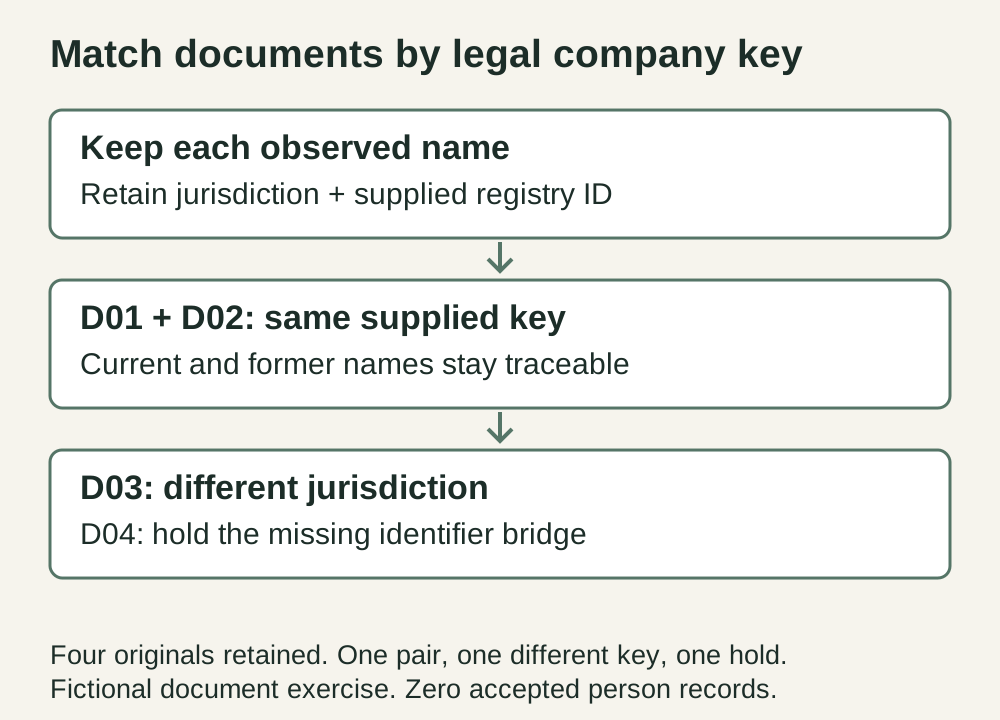
Match four fictional documents by jurisdiction and registration ID
The documents, names, jurisdictions and identifiers below are entirely invented. JUR-A, JUR-B and DEMO-0042 are teaching labels, not real registration references. The task is only to decide which supplied documents identify the same company record. It does not approve a target account, resolve a person's employer or determine a contractual counterparty.
The case stipulates that D01's company-controlled notice identifies its service operator by jurisdiction and registry ID, and that D02 is the corresponding registry's current record including its former-name history. Those source relationships are given facts of this fiction. In real work, retain the actual notice URL, registry reference, date and exact statement; do not assign authority because a document merely looks official.
| Document and observed name | Supplied jurisdiction and ID | Exact evidence and bounded decision |
|---|---|---|
| D01 · Demo Alder Cloud | JUR-A · DEMO-0042 | The notice identifies the service operator as Demo Alder Systems Ltd with this key. Retain the brand as the observed name and the operator statement separately. |
| D02 · Demo Alder Systems Ltd | JUR-A · DEMO-0042 | The supplied registry record lists Demo Alder Apps Ltd as its former name. Match D01's stated operator to this record; retain both current and former names under the same supplied key. |
| D03 · Demo Alder Systems Ltd | JUR-B · DEMO-0042 | Same visible name and number characters, different jurisdiction. It does not match the JUR-A record. Preserve it as a separate supplied key. |
| D04 · Demo Alder Cloud | JUR-A · ID not supplied | A separate page shows the brand but supplies no registration reference or supported bridge to D01. Hold the document relationship; do not fill its missing ID from the matching name. |
The output has one matched pair, D01–D02, covering two originals; one nonmatching keyed document, D03; and one held document, D04. That accounts for all four inputs. D02's former name stays attached to its supplied record history rather than becoming another legal-entity record. The outcome contains zero accepted person records and no account-fit decision.
Keep the original identifier spelling. Do not remove leading zeroes, punctuation or prefixes merely to make two references compare equal unless the actual registry documents that equivalence. Here, exact identifier equality is a case assumption. D03 demonstrates why the jurisdiction must remain part of the key; D04 demonstrates why a repeated brand label cannot supply a missing registration reference.
A compact decision receipt makes the result reusable without turning it into a prospect payload:
Case: four fictional documents; no live registry query
Matched documents: D01 and D02
Supplied key: JUR-A / DEMO-0042
Observed brand in D01: Demo Alder Cloud
Operator named by D01: Demo Alder Systems Ltd
Current name and former-name evidence: D02
Former name retained: Demo Alder Apps Ltd
Different key retained separately: D03 / JUR-B / DEMO-0042
Unresolved bridge: D04 / no supplied registry ID
Person affiliation, account fit, contact action: not decided
Hand the legal-record result to the account-selection owner
Carry the jurisdiction, identifier, observed name and exact source scope into the existing target-account selection guide. That guide owns account fit, exclusions, brand changes and operating-unit decisions. A supported legal-record match is evidence for that work; it is not a substitute for it.
In particular, matching D01 to D02 would not establish whether the business belongs in a service brief, whether an existing-client restriction applies or which operating team owns a project. Keep those questions with the account owner. A company that is correctly identified can still be outside the research job.
Once that broader decision is complete, the company-audience guide covers the separate people-search and CSV-review stage. Retain the observed employer label instead of replacing it with a researched legal name by default. Current person affiliation and responsibility still need their own evidence.
Know when one name should not become one account
A shared brand with regional entities is one counterexample. A franchise network is another possible structure: a common public identity need not establish one local operator. These are research questions, not assumptions about a particular company. Find the relevant official or company-controlled evidence before deciding how the accounts relate.
A change of registered name with a continuing registration identifier is a different pattern. Preserve the earlier name as historical evidence rather than create a second current account automatically. Equally, do not infer continuity from a similar new name when the identifier or business transfer relationship is unknown.
Acquisition announcements also need careful reading. An announcement of an intended acquisition does not establish that every operating entity has merged or that all employees share one employer. Keep announcement status, date and scope. If your task depends on the completed structure, seek the later evidence that resolves it.
Recover an unsupported document match
If earlier research joined documents by name alone, return to the retained originals. Extract the jurisdiction and registration reference each source actually supplied, keeping blank values blank. Separate a record's own former-name history from a similarity inferred across two different records.
For an existing match, record the evidence that supplied the bridge. If the only reason is “same brand” or “same number,” reopen the decision and check the missing jurisdiction or source relationship. Do not silently replace the old conclusion: preserve the earlier decision and add the correction so a colleague can understand why the link changed.
If only an edited summary remains, it may be impossible to recover the original relationship from that summary. Seek the source document or hold the link. A newer timestamp, a successful enrichment job or a longer account list cannot replace the missing identifier evidence. The enrichment reconciliation guide can preserve conflicting supplied fields, but it cannot settle this documentary relationship.
Collect only the people your account brief can explain
Finish the legal-record note with each source name, jurisdiction, supplied identifier, evidence link and match decision. Give it to the account-selection owner before collecting profiles. They should be able to distinguish the supported document pair from the nonmatching key and the unresolved bridge, without treating any of them as a person-affiliation result.
If profile input is missing, Leadsforlinked's existing free entry provides 100 profile leads once at signup, without a card, released in batches of 20. Check the real sample against your account brief. The offer supplies profile input; it does not verify entity relationships or qualify people for contact. Keep a sufficient existing source when it already completes the job.