Start with customer evidence you can explain
A target account list is a buying decision about where your team will spend research and outreach time. Start with actual customer outcomes, delivery experience and repeatable problems. Do not simply copy the industries of your largest invoices. A large customer can have bought through an unusual referral, required work you cannot repeat, or created support demands that made the relationship unattractive.
Review a small, meaningful set of customers with the people who delivered the work. Record the problem they hired you to solve, the conditions that made the project workable, the team that owned the problem and the reasons the relationship lasted. Keep the observation separate from the proposed targeting rule. “This customer has several operating locations” is evidence; “all companies with several locations are good prospects” is an assumption to investigate.
LinkedIn's March 2026 account-targeting guidance recommends looking for patterns among valuable existing customers and revisiting the resulting criteria. Use that starting point, then add your actual delivery constraints. Avoid presenting a convenient industry or headcount filter as proof that a company has your customer's problem.
Write must-not-serve rules before searching
Put non-negotiable exclusions in the brief. They can include markets you cannot support, an employer type your service does not suit, existing customers assigned to another team, a required implementation condition, or a business model you have deliberately declined. State the reason and the person responsible for the rule. A must-not-serve condition should not disappear because the search returns fewer people than expected.
Separate those exclusions from preferences. A preference such as a familiar technology can help order research, but a missing technology observation is different from a proven mismatch. Use an explicit hold when evidence is absent. That makes the next research action clear and prevents “unknown” from becoming either an automatic approval or a silent rejection.
A recent firsthand narrow-ICP discussion describes a consulting client with specific geography, headcount, industries and titles, alongside difficulty finding active profiles. It is an individual experience, not a market-size estimate. Its useful question is whether a team should broaden fit to meet a quantity expectation. Record any deliberate brief change as a new version and compare the new audience with the previous requirement.
Use native account search as a candidate source
Before buying another source, inspect your CRM's existing accounts, the customer's own company information and the account search already available in your stack. LinkedIn documents separate account and lead filters, include/exclude controls and saved lists. Those can already meet a research-and-save job. This guide does not require Sales Navigator when ordinary LinkedIn research supplies the companies you need.
The current LinkedIn help page also says a lead search with no results may adjust a filter and show closest matches, identifying the change. Inspect the actual filters beside the results. Do not accept a near match that violates an approved geography or company condition just because the interface supplied it. Keep the original brief, the search settings and any deliberate revision together.
Search settings produce candidates, not approved accounts. Review the business description, relevant operating entity and evidence for the problem. If the native source gives you an adequate approved list and no portable profile payload is needed, the job can finish there. An external purchase must supply a remaining output requirement.
Approve the company identity, not just its name
A parent, subsidiary and regional brand can share a website domain while serving different markets. Store the exact company page and the entity you intend to target. Keep the source spelling of its name. If a CRM record represents a group but your brief concerns a subsidiary, record that relationship rather than silently replacing one with the other.
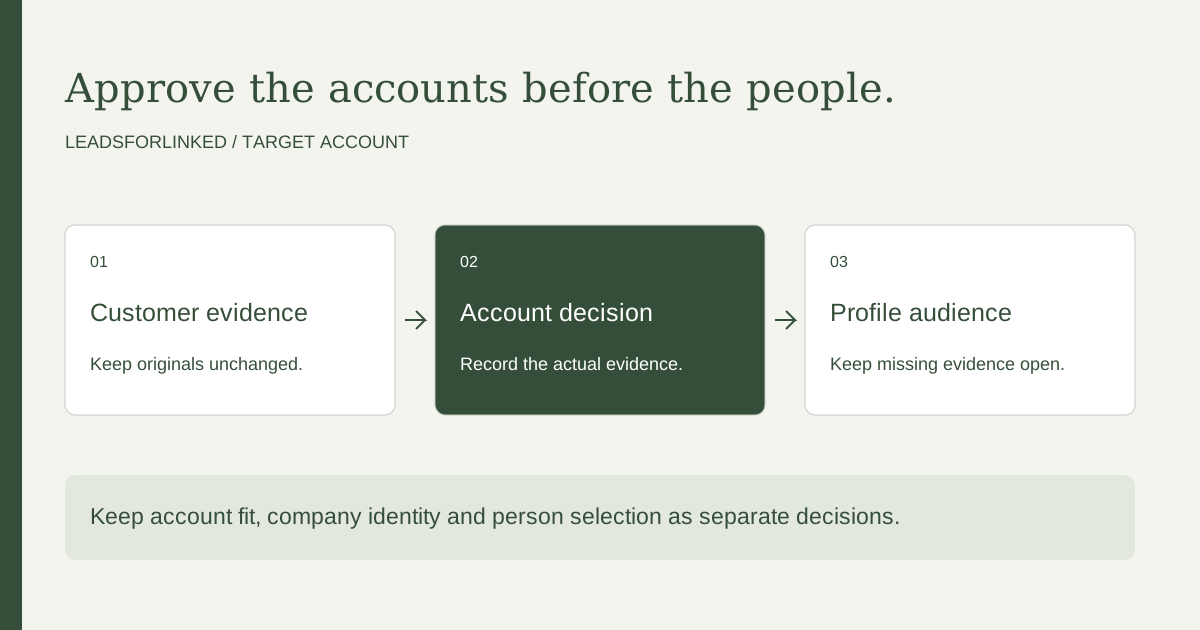
Use a short account ledger with three decisions: approved, held or outside the brief. An approved record needs enough evidence for the actual criteria and an unambiguous account identity. A held record needs a reason, an owner and the next piece of evidence. An outside-scope record stays visible in the working ledger so another researcher does not repeat the same work.
Approval should answer why this account belongs in this job. It does not prove buying intent, a budget or an available buyer. Store those later observations separately. If the target brief requires a specific office or operating region, check that evidence directly; headquarters location alone cannot establish where the buying team works.
Translate approved accounts into a profile audience
For each approved company, define the responsibilities your receiving team needs to research. Start from the problem, then list relevant title variations. An operations project may need the person accountable for the process, an implementation evaluator and the manager affected by adoption. A senior title alone should not make someone a match for every responsibility.
Run company-scoped people research and review the actual employer association. Preserve the account identifier beside each person. A source name and a company name are useful observations, but names alone are weak join keys. Keep public person identity, expected account and observed account distinct, particularly when the company has recently changed brands or a person has changed jobs.
The substantial deliverable is the accepted profile audience across the approved accounts, with enough context for the next team to use it. Record the actual accounts and responsibilities still missing. Do not treat the account count multiplied by a guessed number of people as a production forecast. Use the committee coverage workflow when the next job needs evidence about who participates in a particular decision.
Review a fictional account-to-person case
The download pack contains six fictional account observations and eight person observations. Its brief concerns software employers in France and the United Kingdom with an identified process owner. Agencies and unsupported geographies are excluded. Unknown process ownership and an unresolved parent/subsidiary identity remain held. Every identity is synthetic and do-not-contact.
Two accounts pass this teaching brief. Four profile observations at those accounts are accepted for the requested operations responsibility. A finance-only role and a person attached to an unapproved account are rejected for this job. A missing title and an opaque Sales Navigator identifier stay held. No name splitting, URL path replacement or missing company evidence is invented to make the counts look better.
The expected decision ledger embeds each original account and person observation unchanged. Accepted account records remain separate from accepted person records. This lets you inspect whether a person was admitted through an approved account, rather than checking only the title. The held subset keeps unresolved evidence available for later review. These handwritten counts explain the case; they establish no actual source coverage or conversion rate.
Use the blank brief for a repeatable job
Complete the blank brief with customer evidence, mandatory conditions, exclusions, exact account identities and required responsibilities. Add the receiving owner and the output they can accept. Assign a reviewer for any proposed expansion of geography, company model or role scope. Store the decision date so a later team can see which version it received.
Review profile output against that brief before increasing extraction. Keep the untouched export, a decision ledger and a separate accepted audience. When the next capture overlaps the previous one, use the snapshot comparison to identify new and changed observations. A missing profile in a later file does not establish that the person has left the company.
Set the remaining job from observed gaps: approved accounts with missing responsibilities, profiles with unresolved identities, or fields required by the receiver. Existing customers and current opportunities need the team's account-handling decision before outreach. A person-level CRM exclusion file alone does not protect an entire client account.
Download the decision pack
- Blank editable job worksheet
- Untouched fictional observations and case contract
- Expected decision ledger with every original retained
- Accepted inspection subset and held inspection subset
These JSON files preserve teaching observations for review. The column labels are our case schema. Use your actual source file and destination mapping for a production job.
Move from a sample to the remaining audience
If the approved accounts require a portable profile audience that native routes still do not provide, test the supported LinkedIn source with Leadsforlinked's 100 free signup profile leads, no card, released in batches of 20. Inspect the actual CSV for usable identities, employer context and the fields your job needs. Your sample decides whether this source fits the brief.
After accepting the sample, compare the remaining extraction with the eligible once-only 500-profile offer at €1.99 or Basic at €4.99 monthly and €35.88 yearly, equivalent to €2.99 monthly. Keep research, enrichment and sending tools that meet their stages. Recurring extraction is justified by a repeated, proven audience requirement; a blank worksheet or a larger search count is not that requirement.
Sources and scope
Linked primary guidance and firsthand discussion were read on 13 October 2026. The original work product is a fictional decision exercise and a reusable blank brief. Use current local settings and actual source observations for your job; an authenticated import or source run is not claimed here.
Frequently asked questions
Should I build the account list or the people list first?
Approve exact company identities against customer evidence and exclusions first. Then select profiles for the responsibilities required at those accounts.
Can I broaden the filters when too few profiles appear?
Record the shortfall and any native filter adjustment. A deliberate brief revision should preserve the earlier requirement and explain which condition changed.
Does an approved account imply buying intent?
No. Account fit identifies where research is useful. Budget, project participation and buying intent require separate evidence.
What should the free sample prove?
It should supply the actual identities, employer context and fields needed for your approved audience. Accept the sample before choosing more extraction.