A team selling an onboarding implementation service may need to understand both the operating handoffs and the supplier-review process. Putting every operations, finance and procurement title into one large search can produce a mixed list with no clear reason for the next conversation. Separate the jobs before you collect more profiles.
The example below uses three invented software-employer labels: A1, A2 and A3. Assume those accounts have already passed the team's account review. There is no real prospecting project or active purchase behind the example. If you still need to choose the companies, use the existing target-account workflow first.
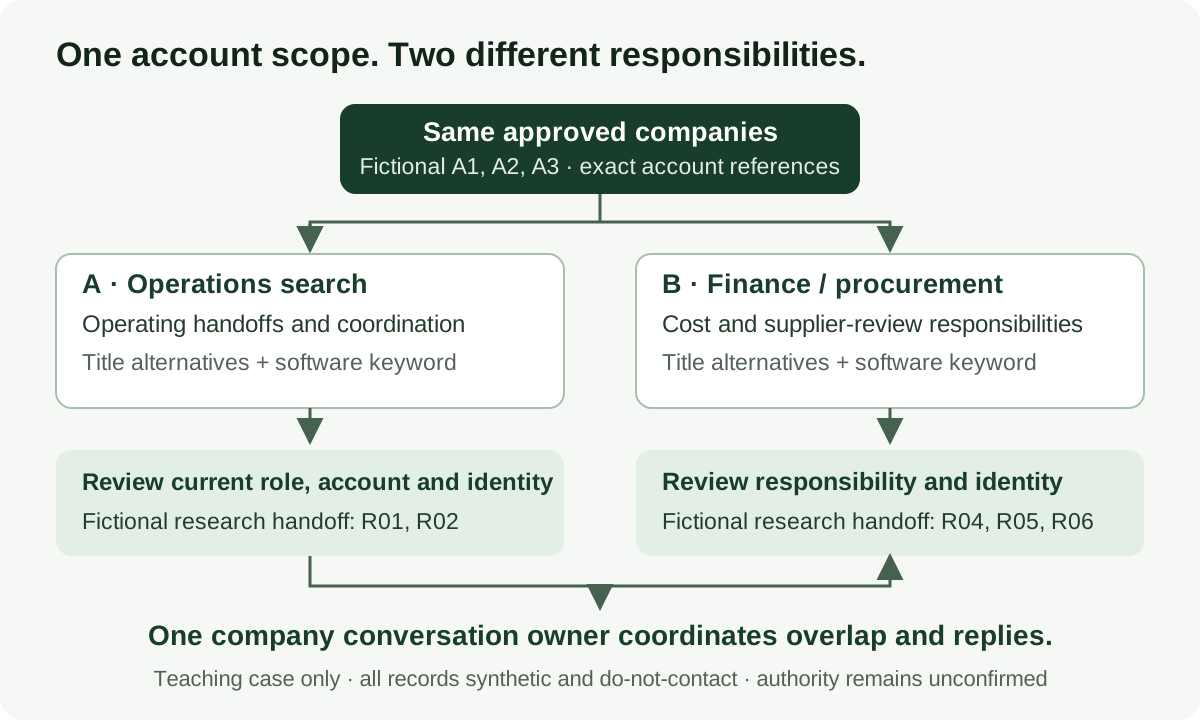
Keep one account scope and two review questions
Lane A asks who owns the operating work: onboarding handoffs, implementation coordination or the affected process. Lane B asks who can explain the commercial review: supplier cost assumptions, evaluation requirements or procurement onboarding. Finance and procurement are grouped here for a small team's first research pass; separate them further if their actual jobs differ.
Record the exact approved company reference beside every person. Neither a senior title nor the word software establishes that relationship. One person can cover both responsibilities, and a missing role should remain an open question. The buying-committee guide covers the later task of establishing project participation and authority.
Copy the two starting queries
In the Sales Navigator URL Generator, enter each lane's titles on separate lines. For both drafts, put intern in Exclude keywords, leave Location keyword blank, and put software in Industry or company keyword.
| Actual control | Lane A: operations | Lane B: finance / procurement |
|---|---|---|
| Job titles | Head of Operations Director of Operations Operations Manager | Finance Director Chief Financial Officer Procurement Manager |
| Exclude keywords | intern | intern |
| Location keyword | Leave blank | Leave blank |
| Industry or company keyword | software | software |
Query A: operating responsibility
("Head of Operations" OR "Director of Operations" OR "Operations Manager") AND software NOT (intern)Query B: finance or procurement responsibility
("Finance Director" OR "Chief Financial Officer" OR "Procurement Manager") AND software NOT (intern)These exact Boolean strings were generated and copied in the public tool on 30 October 2026. The generator also produced standard LinkedIn and Sales Navigator starting URLs. No LinkedIn search was opened for that check, and no resulting people, filters or account access were verified.
The software field adds a keyword. It does not select an Industry or Current company filter. Apply the available native filters for the real company and geography requirements, then inspect the actual profiles. Standard LinkedIn and Sales Navigator have different account access and filter behavior; a generated link does not reproduce a paid filter or guarantee either route's results. For URL construction details, use the existing build-a-search-URL guide.
The NOT (intern) clause is deliberately a term to test. It is not an approved exclusion for every operational or commercial search. Keep it only if reviewing the actual search with and without it supports the decision.
Review twelve fictional role observations
Every observation and decision below is authored teaching data. A1–A3 are invented account labels. All twelve records are synthetic=true and do_not_contact=true. They are not extracted profiles, customer evidence or people to look up.
The word check column is a simple teaching predicate: look for one of a lane's exact title phrases and the word software anywhere in the observation, then remove it if intern appears. It is case insensitive. This deliberately simple check explains mistakes; it does not simulate LinkedIn search, ranking, visibility or current-role matching.
| Case | Fictional observation | Word check | Manual decision and reason |
|---|---|---|---|
| R01 | Head of Operations Current Head of Operations at A1, a software employer; owns onboarding handoffs. | A | A — accept for fictional research Current operational responsibility and account association are stipulated; budget authority is unconfirmed. |
| R02 | Operations Manager Current Operations Manager at A2, a software employer; coordinates implementation scheduling. | A | A — accept for fictional research The operating task fits Lane A. Seniority is not being used as proof of purchasing authority. |
| R03 | Customer Adviser Current Customer Adviser at software employer A1; formerly Director of Operations. | A | Hold — former-role match The operations phrase is historical. Do not treat it as the current responsibility. |
| R04 | Finance Director Current Finance Director at software employer A1; reviews supplier cost assumptions. | B | B — accept for fictional research Commercial-review relevance is stipulated. This does not establish who approves the budget. |
| R05 | Chief Financial Officer Current Chief Financial Officer at software employer A2; finance remit is documented in the case. | B | B — accept for fictional research Finance responsibility fits Lane B. Project involvement and approval authority remain unknown. |
| R06 | Procurement Manager Current Procurement Manager at software employer A3; reviews supplier onboarding requirements. | B | B — accept for fictional research The supplier-review task fits Lane B. It is not evidence that a procurement is under way. |
| R07 | Business Operations Lead Current Business Operations Lead at software employer A3; owns the relevant handoff process. | Neither | Hold — title variant missing Responsibility looks relevant, but this title is absent from the draft. Record a proposed revision; do not claim the query covers it. |
| R08 | Chief of Staff Current Chief of Staff at software employer A2; supports commercial meetings, with no clear operating or finance responsibility. | Neither | Hold — responsibility unclear An ambiguous title is not enough to choose a lane. Find the missing responsibility evidence. |
| R09 | Head of Operations Current Head of Operations at an agency serving software companies; employer is outside A1–A3. | A | Outside this account brief The title and software word can match while the employer still fails the approved account scope. |
| R10 | Finance & Operations Director Current Finance & Operations Director at software employer A1; both functions appear, but the relevant project responsibility is unresolved. | Neither | Hold — hybrid role Neither draft contains this exact title phrase. One person may span both jobs; resolve the lane and conversation owner before any handoff. |
| R11 | Head of Operations Current Head of Operations at software employer A2; previously a finance intern. | Neither | Hold — exclusion needs testing The intern exclusion hides a potentially relevant current role in the teaching check. Compare the real search without it before keeping it. |
| R12 | Operations Manager Operations Manager at software employer A3 is claimed in a note, but no usable person identity accompanies it. | A | Hold — identity missing Matching words do not supply a usable person identity or confirm the account association. |
The case produces two Lane A and three Lane B research admissions, six holds and one outside-scope observation. Those counts describe only this authored exercise. The five research admissions remain do-not-contact, and they establish no real acceptance rate or expected audience yield.
Three decisions matter more than the count. R03 matches a former title. R07 exposes a relevant title variant the draft misses. R11 shows how the intern exclusion can hide a relevant current responsibility. Record those gaps before changing a query; do not quietly add every possible synonym or delete a difficult row to make the list look complete.
Keep the filled two-lane brief with the searches
For this fictional case, the team approves the lane split and the review plan. The queries remain drafts for an actual account-scoped test. The brief below keeps the accepted research cases, unresolved evidence and one company conversation owner together. Select and copy it; replace the fictional account labels with verified company references for your own job.
TWO-LANE SEARCH BRIEF — FICTIONAL WORKED CASE
Purpose: research an onboarding implementation service at approved accounts A1, A2 and A3.
Status: lane split and review plan accepted for this exercise; real search/filter/results review still pending.
Shared account rule: current employer must resolve to the exact approved company reference.
Shared exclusions: check existing relationships, contact restrictions and conversation history before outreach.
Contact permission: unassessed. Every example remains synthetic and do_not_contact.

LANE A — OPERATIONS
Responsibility: operating handoffs and implementation scheduling.
Draft: Query A above; NOT intern remains a comparison term until reviewed.
Native-filter intent: approved current-company scope; add actual person geography only if the real brief requires it.
Fictional research handoff: R01 and R02. R03, R07, R10, R11 and R12 require the recorded review.
First conversation job: establish the relevant operating task or answer the task already known.
Research owner: operations reviewer. Reply owner: the existing company conversation owner.

LANE B — FINANCE / PROCUREMENT
Responsibility: cost assumptions, supplier evaluation or supplier onboarding.
Draft: Query B above; NOT intern remains a comparison term until reviewed.
Native-filter intent: the same approved current-company scope; account/product access is checked separately.
Fictional research handoff: R04, R05 and R06. R08 and R10 require responsibility review.
First conversation job: clarify the relevant evaluation or approval step when there is evidence it applies.
Research owner: commercial reviewer. Reply owner: the same company conversation owner.

BEFORE USING REAL RECORDS
Actual query and final filtered URL for each lane:
Actual filter values / account and date checked:
Raw source / required fields / accepted identities:
Held cases / missing title variants / exclusion comparison:
One owner for overlapping identities and the company conversation:
Agreed next step / reply status / follow-up timing:
Keep the original observations alongside this brief. Add the actual final filtered URL, chosen filters and review date after you run each real search. A saved URL reruns a search; it does not freeze an audience. If a hybrid identity belongs in both lanes, have the company owner decide one coordinated approach and retain both responsibility notes.
Give each lane a different conversation job
For an operational owner, the next useful conversation may concern how implementation handoffs work or which part still needs attention. For a finance or procurement contact, it may concern the evaluation step or supplier requirements. Ask the missing question supported by the context you actually have. If the person has already explained the task, answer it instead of sending them through the same discovery again.
A role label does not prove that either conversation is timely. Before outreach, check the actual person, company history and applicable contact restrictions. Preserve who has already replied and what they asked for. A second lane should not restart the same company introduction or continue an obsolete sequence after the conversation changes.
When the reviewed audience is ready for ongoing prospecting, Leadsforlinked's broader workflow covers relevant targeting, LinkedIn message sequences, replies and follow-up. Its published Starter plan is the paid campaign route, with multi-step LinkedIn campaigns, reply tracking, a unified inbox and a Kanban pipeline. This query generator does not create campaigns or activate those paid features.
Plan lane-specific sequences within the controls available to your account, and assign one owner to handle replies and the next agreed step. Keep the operational and commercial message purposes distinct. The existing audience-to-campaign guide covers that separate stage; this article does not claim a completed import, campaign launch or message send.
What was checked
The two generator input/output and copied-query checks were observed on 30 October 2026. The role observations and decisions are fictional, and the word-check column is a literal teaching rule. No LinkedIn result set, authenticated filter selection, extraction or campaign execution is presented.
LinkedIn's Boolean search guidance and Sales Navigator Boolean guidance support the query syntax. Its filter definitions distinguish current-role, company and geography conditions. Those references were checked for the existing search guide on 18 October 2026; no fresh source check or account entitlement is claimed here. Use the actual search interface and current account messages for your job.
Frequently asked questions
When should I split buyer roles into separate searches?
Split them when the responsibilities require different review criteria or different conversations. Keep the same approved account scope, then record the responsibility, message purpose and owner for each lane. Two lanes are a useful choice for this example, not a required committee size.
Does the software keyword select a company industry?
No. It is a keyword clause and can occur in unrelated or historical profile text. Review the current employer against your approved accounts and use available native company or industry filters where appropriate.
Should I keep NOT intern in both queries?
Treat it as a comparison draft. The fictional R11 case shows why a word in a past role can hide a relevant current role. Compare the actual search with and without the exclusion before adopting it.
Does a finance title identify the budget owner?
No. A current finance or procurement responsibility can justify further research, but budget authority and participation in a particular purchase need separate evidence.
Can the URL generator run these campaigns?
No. It prepares keyword queries and search URLs. The published Starter plan is the separate paid route for multi-step LinkedIn campaigns and reply handling. A generated URL or this fictional exercise does not activate those features.