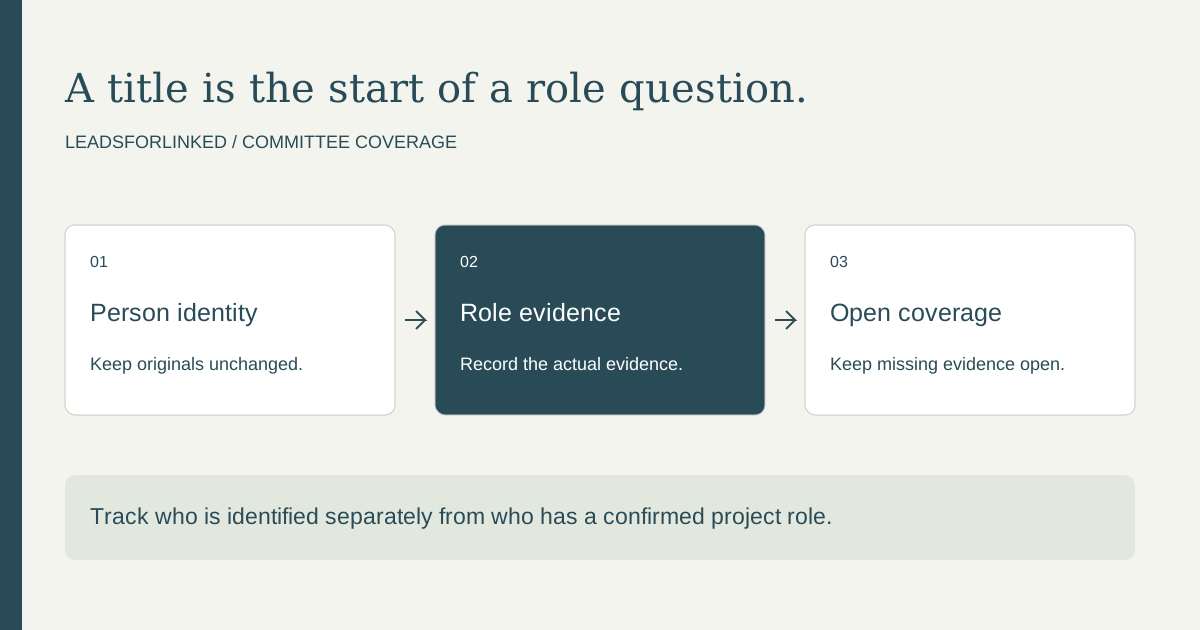
Define the decision before mapping the committee
A buying committee map is useful only when it concerns a defined decision. Write the product or service being considered, the operating problem and the part of the organization affected. A company-wide directory can help with research, but it cannot tell you who participates in a particular procurement. Different projects at the same employer can have different evaluators, sponsors and approval paths.
Ask the account owner what is known and what is assumed. A request for a demo, a referral, an existing customer expansion or a cold account investigation can each start a map, but they carry different evidence. Keep the source of the project context beside it. An event membership or a content reaction can explain why someone entered research; it does not establish that a purchase is happening.
A recent industrial-sales discussion asks about economic buyers absent from LinkedIn, procurement access and handoff at initial interest. These are practitioner questions rather than a performance benchmark. They underline a practical limit: an accessible profile audience can support coverage research while still leaving important participants unidentified.
Inspect the map your existing stack already provides
LinkedIn's Relationship Maps documentation describes list and map views, role labels, owner assignment, notes and placeholder cards. Advanced and Advanced Plus users can share maps; Advanced Plus can update CRM records when admins enable the feature. A native map can already serve the account team's collaboration job.
The same documentation notes that adding a person from outside the saved account does not change that person's company to the mapped account. Preserve that distinction when a group project includes a subsidiary or outside adviser. A placeholder can represent a person who is not yet identified or has no LinkedIn profile, rather than forcing an arbitrary visible person into the empty position.
Use your CRM's existing contact roles, notes and account ownership too. If these native tools provide the needed identities, evidence and handoff, keep them. An external profile audience has a role when the receiving team needs reviewed people across accounts, a portable research subset or source context that remains missing. The existence of a blank map alone is not a reason to buy extraction.
Separate identity, responsibility and authority
Track three different questions for every candidate. Is this the intended person? Is their current employer or project association established? What evidence supports the role assigned in this decision? A director's title may suggest a useful research path, but it cannot establish budget authority, willingness to sponsor a project or ownership of security review.
Use responsibility labels that fit your actual process. You might need operational evaluation, economic approval, procurement and security review. Another job may involve legal, adoption management or an external consultant. The labels are prompts for evidence, not a universal required committee size. One person can hold several responsibilities, and one responsibility can have several participants.
Keep an inferred role explicitly unconfirmed. A meeting note naming a person as the implementation evaluator can support that role for that project. It may say nothing about approval authority. Record the evidence holder, date and what the statement actually establishes. A colleague's recollection that someone is “the decision maker” needs enough context to distinguish formal approval from influence.
Measure open coverage rather than collect titles
A useful coverage worksheet has one row per responsibility and candidate association. Include the exact account, project, person identity, observed title, inferred role, evidence, status, owner and next action. A missing person remains an open row. A named candidate with no role evidence remains unconfirmed. Those states tell the account team what to resolve next.
Keep identity acceptance separate from role confirmation. A profile can be suitable for further research while economic approval remains unknown. Likewise, a role can be described by a customer without a usable LinkedIn identity. That is a different gap: the person may need another identification route, rather than another title search.
Report coverage in the vocabulary of the decision. State which responsibilities have evidence, which have candidates and which remain open. Do not relabel candidate count as committee completeness or purchasing intent. A diagram filled with senior people can still omit the operational team that will decide whether an implementation is viable.
Keep company relationships and changes visible
Store the expected account alongside the observed employer. If an adviser participates in the project from another company, record the relationship and the evidence permitting that association. Do not change their employer to the customer's company to make an account filter match. A former employee should not remain current merely because an older map included them.
Review job changes and conflicting observations before adopting the next export. Preserve the original title and employer values; put later researched observations in separate fields. If the same identity has incompatible current-employer evidence, hold the association until someone resolves it. Selecting the newest file is an ordering rule, not proof that it is correct.
Build profile audiences from approved target accounts when the project is still an account research exercise. Reuse known people already in the receiving system. If a contact is present under a different account relationship, bring that case to the account owner instead of creating another person solely to fit the map.
Inspect a fictional committee with three roles still open
The original exercise concerns a fictional operations-software project with four responsibilities: operational evaluation, economic approval, procurement and security review. It supplies eight handwritten profile observations. Every identity is synthetic and do-not-contact. The fictional meeting notes are teaching evidence, not a record of actual customer conversations.
Three person observations are accepted for research. The internal security reviewer has explicit project-role evidence. A chief executive and a procurement manager are identifiable candidates, but their titles alone do not confirm economic approval or procurement participation. The operations observations share a profile URL but contain different observed names, so both remain held despite the supplied project notes. The expected coverage is one evidenced responsibility and three unconfirmed responsibilities.
Four observations stay held: the two conflicting-name observations, an outside consultant without project-association evidence, and a missing person URL. A proven former employee is outside the current project audience. Repeated identity alone does not resolve conflicting names: preserve every original and investigate the identity group rather than choose the first observation. The expected ledger and separate accepted/held subsets retain that uncertainty.
Hand off evidence and the next question
Use the blank worksheet to record the actual project and responsibilities. Add the receiving account owner, evidence source and the next action for every open row. A good handoff lets the next person ask a specific question: who approves this spend, who evaluates the implementation, or who owns the relevant policy review?
Keep conversation context separate from profile data. A CSV of people cannot recreate a message thread or an account owner's knowledge. If the receiver needs a conversation excerpt, provide it through the team's approved record process and identify what is still missing. Native team sharing and CRM notes may already be the best location for that context.
After the handoff, update the map only from new evidence. A successful introduction can establish access; it does not necessarily establish authority. A response asking for information can establish interest in receiving information; it does not necessarily establish an active purchase. Keep those observations specific so the map stays useful when another teammate takes over.
Download the decision pack
- Blank editable job worksheet
- Untouched fictional observations and case contract
- Expected decision ledger with every original retained
- Accepted inspection subset and held inspection subset
These JSON files preserve teaching observations for review. The column labels are our case schema. Use your actual source file and destination mapping for a production job.
Use extraction for the unresolved profile audience
If native lists and existing contacts still miss required profile inputs, test a supported source with Leadsforlinked's 100 free signup profiles, no card, released in batches of 20. Review the actual identities, employer context and fields. An extraction sample can establish whether a source supplies usable people; role evidence still needs the project's research and conversations.
Count the additional accepted profiles required across the approved account jobs, rather than paying to fill boxes with unrelated people. Compare the eligible once-only 500-profile offer at €1.99 with Basic at €4.99 monthly or €35.88 yearly, equivalent to €2.99 monthly. Keep your mapping, research and sending stack. Repeated sourcing can justify recurring extraction only after the actual audience requirement is demonstrated.
Sources and scope
Linked primary guidance and firsthand discussion were read on 13 October 2026. The original work product is a fictional decision exercise and a reusable blank brief. Use current local settings and actual source observations for your job; an authenticated import or source run is not claimed here.
Frequently asked questions
Does a job title establish a buying role?
No. A title can guide research. Project participation, budget authority and approval responsibilities need separate evidence.
How many people should a buying committee contain?
Define the responsibilities for the actual decision. One person may hold several roles, and some participants may not have accessible LinkedIn profiles.
Should I use Sales Navigator Relationship Maps first?
Yes when your existing map supplies the needed collaboration and evidence. A portable external profile audience is useful only for a remaining output requirement.
Does full profile coverage prove buying intent?
No. Identity coverage, confirmed responsibilities and purchasing intent are separate observations.