Buy outreach software for the period in which you need to operate the campaign and manage its replies, not simply for the weeks in which new messages are scheduled. A finite campaign can suit a monthly subscription. A one-off research list may need no outreach subscription at all. An annual quote should be compared with its full obligation, even if the seller presents a monthly equivalent.
This guide is for a consultant, recruiter or small team with a known next campaign and an uncertain later one. It separates software cash cost, human responsibility and the access needed after sending ends. The worked cases and budgets are fictional planning examples, not customer results or promises about how a particular account will behave.
Name the job before choosing the billing period
Write the intended finish in one sentence. “Review a list of relevant people and give it to the account owner” is a research job. “Run an approved six-week sequence and handle the resulting conversations” includes a continuing operational job. A subscription that helps with the second does not become necessary for the first merely because the list might be used later.
Check whether your current tools already cover the work. An established sender and conversation record may be sufficient. Keep them when they meet the requirement; another audience source does not require moving the entire workflow. Conversely, an existing spreadsheet of names does not replace a campaign workspace when you genuinely need sequence controls and organised replies.
The existing occasional extraction guide compares profile allowances and extraction access. This article answers a different question: how long to buy campaign access and who remains responsible when the last scheduled message has gone.
Case one: a research-only list ends at a reviewed handoff
Fictional case A. Example Advisory wants to inspect 24 selected professional profiles before deciding whether a service segment deserves further work. It has no approved outreach campaign and already keeps its relationship history elsewhere. The useful output is a reviewed file with keep, hold and exclusion notes.
There is no campaign software requirement in that brief. The team can use an appropriate existing source or evaluate Leadsforlinked’s free profile path: 100 profiles once at signup, released in batches of 20, with CSV export and no card required. Inspect the actual fields and remaining allowance. The example does not assume that every exported row is suitable or that profiles include verified email addresses.
Do not subscribe to Starter simply to make this handoff appear more complete. Free extraction is separate from paid campaigns. If additional profiles are genuinely needed, compare current eligible packs or Basic extraction access using the pricing guide. That is a sourcing decision, not a reason to launch messages.
Case two: six weeks of sending, a longer reply responsibility
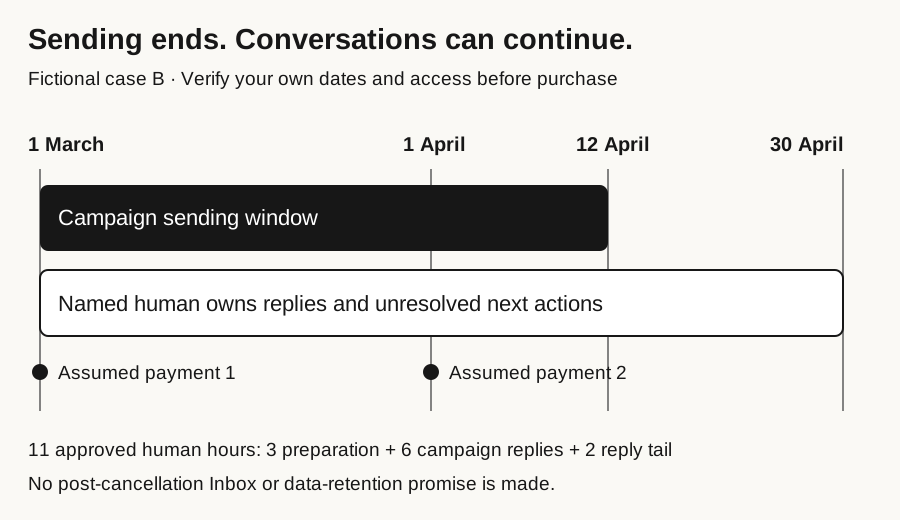
Fictional case B. An adviser has a reviewed audience and one authorised LinkedIn sender. The campaign plan runs from 1 March through 12 April in an illustrative year. The adviser reserves time through 30 April for questions and agreed follow-up, even though no new prospecting step is planned after 12 April.
For this calculation only, assume the selected monthly subscription begins on 1 March and renews on 1 April. The buyer expects to need access through 30 April. That is two paid monthly periods, not six weekly payments and not automatically one month. The dates and billing alignment are invented; use the actual renewal dates shown in your own account.
The campaign end means “stop adding planned prospecting activity.” It does not mean “ignore replies after this date.” A person may ask about the service, raise an objection, refer you to a colleague or request no further contact. Each answer changes the next action. A named human needs the conversation context and a way to check any remaining scheduled action.
If an appropriate conversation continues into May, revisit the access requirement. You may need another paid period, or a deliberate handoff to a sufficient existing workspace if the product and your permitted use support it. Do not assume post-cancellation Inbox access, a complete export or successful reactivation. Resolve the actual route before relying on it.
Keep the subscription subtotal and the time budget separate
Fictional staffing assumptions for case B: three hours for audience and sequence review, six hours for reply handling during the campaign, and two hours for the April reply tail. The adviser approves that eleven-hour allocation before buying. These are planning inputs, not measured hours saved or an expected response rate.
| Budget item | Input | Interpretation |
|---|---|---|
| Software access | Two monthly periods at the selected current price | Cash subtotal; verify the real account offer and dates |
| Preparation | 3 approved hours | Review recipients, relationships, sequence and sender |
| Campaign replies | 6 approved hours | Read, answer, escalate and record the next action |
| Reply tail | 2 approved hours | Continue appropriate conversations after sending ends |
| Internal time value | 11 hours × hypothetical €50 = €550 | Planning value, not another software invoice |
Leadsforlinked’s current advertised monthly Starter offer is €29 for one connected account, with campaigns, follow-ups, Inbox, Kanban and analytics. At that unchanged monthly price, two payments would give a €58 software subtotal. Adding the fictional €550 time valuation gives €608 for this limited planning comparison. It is not a checkout total, a tax quotation or proof that the workflow has run.
If the reply workload needs four more hours, add €200 to the time valuation under these assumptions. Do not call the original budget a saving and hide the extra work. If nobody can own those hours, the campaign is not ready simply because the software payment is affordable.
Compare a full annual obligation with the actual monthly horizon
Separate hypothetical quote exercise—not a Leadsforlinked offer: Example Software quotes €40 for a monthly period or €480 for a full annual period. The annual figure has the same €40 monthly equivalent; this exercise assumes no annual discount. Neither quote is a market benchmark or a real vendor price.
| Access assumption | Monthly cash subtotal | Annual quoted obligation |
|---|---|---|
| Only the two periods in case B are needed | 2 × €40 = €80 | €480; do not prorate it to €80 |
| A third period becomes necessary | 3 × €40 = €120 | Still €480 under this hypothetical fixed quote |
| Twelve periods are genuinely needed | 12 × €40 = €480 | €480; cash timing and terms still matter |
The first case favours the smaller monthly commitment under these inputs. It does not prove monthly billing is universally better. A real annual offer could have different features, payment timing or contractual conditions. Read them rather than infer an annual discount or a right to recover the unused months.
Do not count a possible autumn campaign as a confirmed requirement just to make an annual purchase look justified. Record it as uncertain and set a decision date. If the annual option solves a genuine recurring need, explain that need; “the equivalent monthly number looks low” is not enough.
Read cancellation and access as different questions
The published Leadsforlinked terms, labelled 7 May 2026 and checked on 7 November 2026, state that cancellation takes effect at the end of the current billing period and that partial periods are not prorated. That is a documented term, not a cancellation action or billing test performed for this guide.
The reviewed material does not establish continued paid Inbox access after that period, a campaign-pause entitlement, retained-data availability or a specific reactivation outcome for your account. Ask those questions before making a plan that depends on them. Cancelling a subscription, stopping queued actions and preserving a conversation record are separate decisions.
For comparison, HeyReach’s own cancellation documentation describes access until the period ends and specific consequences for active campaigns and connected accounts. Those are HeyReach’s stated rules, not Leadsforlinked rules. The useful lesson is to request product-specific answers, not transfer a competitor’s continuity promise to your purchase.
Leave the purchase with an operating plan
For case A, the completed choice is a research handoff with no campaign subscription. For case B, the provisional choice is two monthly access periods and eleven approved human hours, provided the actual account terms and necessary controls support the plan. If access or reply handling cannot be resolved, hold launch rather than make the missing work disappear from the calculation.
The campaign plan should identify the last new-message date, the person responsible for replies, the review before renewal and the route for any later conversation. Before ending access, inspect the current records and any permitted handoff. Do not presume that changing a pipeline stage or opening a conversation has stopped its queued follow-up.
Use the campaign guide for audience state, sequence planning and reply handoff. This buying guide does not certify background execution, automatic reply suppression or uninterrupted access. LinkedIn’s restrictions and your own appropriate use remain part of the launch decision.
Choose the relevant next route
If you have an audience and a funded owner for campaign and reply work, review the outreach platform and monthly Starter offer. Its current paid route selects Starter; review the account, billing period and final offer before subscribing. AI features are not needed merely because your campaign has several steps.
If the next job is still a profile list, use the free export path instead. Buy the missing work when it becomes real. The useful finish is not the longest subscription: it is a campaign horizon whose cash commitment and continuing responsibilities you can explain.
Sources and example boundaries
Written and checked on . The cost examples, hours, scopes and decisions are original fictional planning material. They are not supplier prices, campaign results or proof of purchase fulfilment. No account, payment, campaign or cancellation was operated for this guide.
- Leadsforlinked platform and monthly offer — current declared 965-file source read on 7 November 2026; public web retrieval of this particular page was unavailable. Actual account behavior was not tested.
- Leadsforlinked terms, section 5.3 — official public page read 7 November 2026, labelled 7 May 2026.
- HeyReach cancellation documentation — official indexed text read 7 November 2026; its terms are not attributed to Leadsforlinked.