A useful LinkedIn automation evaluation ends with a decision about the work you need to do. The number of trial days matters only alongside feature access, the moment the clock starts and the financial commitment that follows. A long window can still leave the required task untested if you cannot connect the intended sender or inspect the reply workflow in time.
This guide is for a buyer who already has a suitable audience and needs one sender, a short sequence and personal reply handling. Choose an observable task before comparing offers. Keep the commercial terms beside that task, so you know both what you learned and what you agreed to pay.
Free allowance, trial, paid evaluation and refund promise are different
- Free allowance
- A limited resource or feature allocation. Leadsforlinked’s current signup allowance is 100 profile leads once, released in batches of 20 with CSV export and no card. That evaluates profile input; it does not establish campaign or Inbox access.
- Free trial
- A temporary evaluation offer. Read what is enabled, whether a card is required, when the window begins and whether a subscription starts automatically. The word “free” alone does not answer those questions.
- Paid evaluation
- An amount is due for the evaluation itself. Keep that charge separate from a later subscription and any refund conditions. A low first payment is still a payment.
- Refundable subscription
- The subscription is charged, with a stated route for requesting money back under specified conditions. Cancellation, a refund request, acceptance of that request and money returned are separate states. Do not label the arrangement cost-free before resolving them.
Ask for the selected offer, not an explanation assembled from unrelated landing pages. The plan, account unit, currency, period and any extra fee should describe the same purchase. A promotional page may have different conditions from the ordinary pricing route.
Choose one task you can actually evaluate
For a campaign-and-reply job, a focused brief could be: “Using the intended sender, I can prepare the reviewed audience’s opening and follow-up, read the right conversation, handle a personal response and retain its next action.” Decide what evidence would support each part.
A screenshot of an Inbox button proves that the button is visible. A draft shows preparation. Neither alone establishes message delivery, reliable synchronization or every queued-action rule. Use an appropriate existing conversation or a permitted controlled assessment for the part you need to inspect; do not manufacture prospect replies to make an evaluation look complete.
- Access: which selected plan or trial seat enables the required controls?
- Activation: does the clock begin at registration, verification, payment or connection? Record the actual start and expiry shown, with timezone.
- Commitment: what is due now, what could become due next and who can make or cancel the purchase?
- Finish: what happens to access, active work and the information you need when the evaluation ends?
Prepare before starting when possible: the account owner’s availability, the reviewed audience, message purpose and person handling replies. If setup consumes the window, record that limitation. It is not proof that the product failed, nor proof that the untested workflow works.
Two documented examples: check the selected registration terms
These official pages were read on 7 November 2026. They illustrate different commitment structures; they are not an exhaustive ranking or an account test.
Expandi: a published seven-day window with conversion conditions
The canonical pricing page advertises seven days without an initial charge, followed by the selected billing period unless cancelled. Its Terms, sections 6 and 8, describe trial conditions at registration, automatic subscription commencement unless cancelled before trial end, and termination through account settings or contact.
Resolve before starting: the exact clock trigger, expiry timestamp, card requirement and whether every control or add-on you need is included. Those details were not established by this public-page review. Use the current registration offer; do not transfer another campaign landing page’s wording to it.
HeyReach: a documented no-card trial with a separate paid choice
The registration guide describes a 14-day trial with no card. The plans guide says core features have limited seats and the trial does not automatically become paid: a plan must be selected to continue.
Resolve before starting: your exact seat and feature access, the clock and the trial-end data or handoff arrangement. Do not substitute a separately requested agency trial for the standard offer. Its paid cancellation guide concerns subscription management; it does not by itself establish trial data retention.
For either route, retain the offer and an identifiable end decision. Find the cancellation or upgrade path before depending on it. Reading a policy is useful preparation; it is not confirmation that an account action was completed.
A completed evaluation decision, with two hypothetical timelines
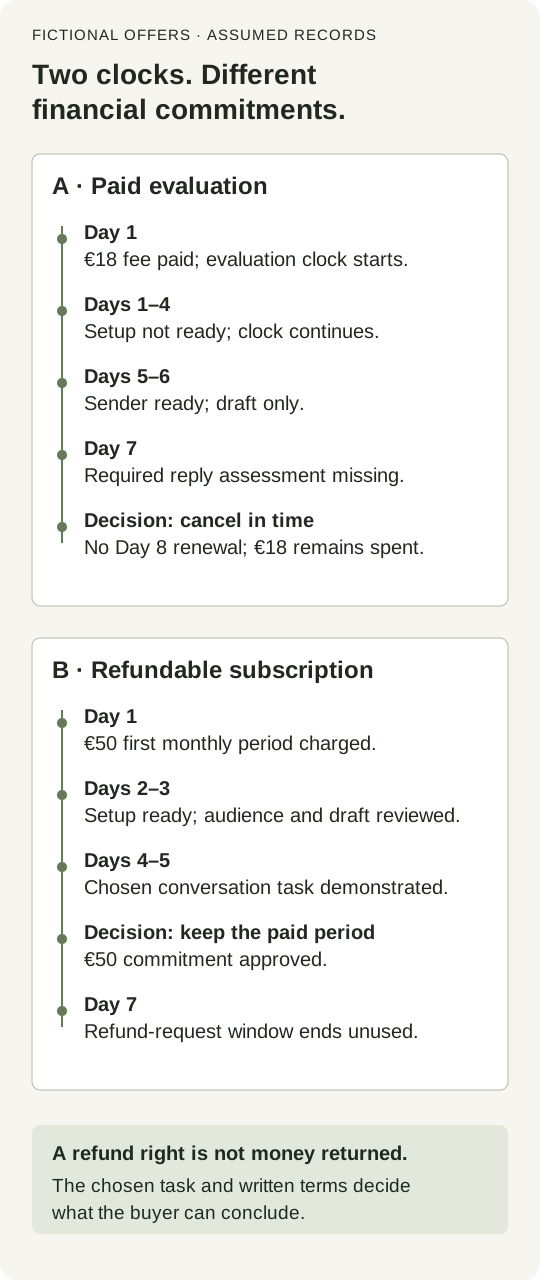
Everything in this exercise is fictional: the buyer, offers, fees, clock days and assessment notes. Neither offer is Expandi, HeyReach or Leadsforlinked, and no account, message, payment or cancellation was operated for this guide.
Ellis has a reviewed audience, one authorized sender and someone assigned to answer personally. The required evaluation is limited: prepare the right sequence, find an existing conversation under that sender, handle a manual answer and retain the next action. A measured response rate, AI reply quality and agency permissions are outside this brief.
Offer A: a paid evaluation, followed by a possible subscription
Assume its written offer requires an €18 non-refundable evaluation fee on Day 1. The clock starts that day and ends after Day 7. A €50 monthly subscription begins on Day 8 unless the buyer cancels in time under those hypothetical terms.
The account owner is unavailable during Days 1–4. Setup is ready on Day 5, and a sequence draft is prepared on Day 6. At the Day 7 decision, Ellis has not obtained the required evidence for personal reply handling. Three days remained after setup, but the chosen evaluation task was not completed.
Decision A: do not authorize the subscription on that record. In the exercise, Ellis completes and retains cancellation confirmation before the boundary, so the €50 renewal is not due under the assumed offer. The €18 evaluation fee remains spent. That is a limited unsuccessful assessment, not a negative verdict on a real vendor.
Offer B: a subscription payment with a refund-request window
Assume a different written offer charges €50 for the first monthly period on Day 1. It permits an eligible refund request by the end of Day 7 under stated conditions. The exercise assumes Ellis meets those conditions; it does not invent a right for buyers of an actual product. There is no separate evaluation fee.
Here setup is ready on Day 2. The imaginary assessment record contains a reviewed audience and draft on Day 3, the intended existing conversation on Day 4, and a personally handled response with its next action on Day 5. These are assumptions for comparing a decision, not product screenshots or real execution evidence.
Decision B: keep the first paid monthly period because the chosen task was sufficiently demonstrated in this scenario and the €50 commitment is approved. Ellis does not request a refund or call the period free. No annual commitment, response forecast or guarantee of future synchronization follows from that choice.
Keep features and evidence in different columns
| Required work | Offer A notes | Offer B notes | What the decision can use |
|---|---|---|---|
| Intended sender available | Ready on Day 5 | Ready on Day 2 | Usable setup time, not the advertised window alone. |
| Reviewed audience and sequence preparation | Draft available on Day 6 | Reviewed draft on Day 3 | Preparation evidence; not a reply-rate or delivery result. |
| Existing conversation and personal response | Required assessment not obtained by the deadline | The assumed Day 4–5 record covers the chosen conversation and manual next action | A’s task remains unresolved; B meets this exercise’s limited criterion. |
| Financial decision | Cancel before conversion; €18 remains spent | Keep the €50 paid period; no refund requested | Neither finish is a free period or money returned. |
If B’s response record were only an Inbox label with no conversation context, the decision would change to a hold. A published feature and a convincing demonstration are not interchangeable with the evidence your requirement needs. Equally, an unobserved capability in A should remain unobserved; do not mark it absent or working to complete the table.
Finish with an operational and financial state
Before the boundary, write one of three decisions: continue with the selected paid commitment; end the evaluation with the required action confirmed; or hold the purchase while a material requirement remains unresolved. Keep the amount already paid beside the possible next charge.
A request to cancel is not the same as confirmed cancellation. A refund request is not a refund received. Retain the confirmation or unresolved status and the relevant deadline rather than relying on a reminder alone. Determine who will handle any existing conversation after access changes; ask about the actual export or handoff route instead of assuming one.
This is the precommitment question. How many months to buy for a finite campaign is a separate budget decision. Likewise, a profile allowance does not establish a campaign evaluation. The existing pricing guide owns the profile-pack and extraction-access choice.
A normal paid plan can be an appropriate choice
We publish Leadsforlinked, so the following product link has a commercial purpose. Its supported route here is the normal Starter offer at €29 per month on monthly billing, for one connected LinkedIn account, with campaigns, follow-ups, Inbox, Kanban and analytics. It fits a requirement for sequences and personal reply handling; AI Responder is a separate Diamond Pro feature.
If that is your repeated task, compare the published outreach platform with your current tools and verify the account offer and controls before subscribing. If a sufficient sender and reply workspace already exist, keep them. If the real gap is only profile input, use the profile and CSV route instead of buying campaign access by default.
Sources and example boundaries
Written against the official pages linked above on 7 November 2026. The Expandi comparison uses its canonical pricing page and Terms; promotional pages were not combined into that offer. HeyReach’s standard trial help is separate from its paid cancellation policy. Exact account clocks, registration requirements and the feature access you receive still need confirmation.
The two evaluation timelines and filled record are original teaching material. They establish no actual vendor performance or account result. Own-product statements use the current published Leadsforlinked platform catalogue; no live trial offer, charge or cancellation outcome is certified by this article. LinkedIn’s automated-activity rules also apply: an evaluation or a delay setting does not establish platform permission or protection from restrictions.