This comparison is for a buyer who already knows where the audience will come from. The question is which selected product completes the next steps: the outreach channel, the person handling replies and the record that another colleague will actually use. Start with those three requirements. Replacing software while leaving the receiving process unresolved simply moves the unfinished work.
Leadsforlinked publishes this guide and sells a separate LinkedIn workflow. The worked decisions below can end with keeping a competitor. They are fictional buying cases, not customer results or product execution tests.
Dux-Soup now means STACKED Local or Cloud
The official STACKED introduction describes a Windows/macOS desktop application and says the former Dux-Soup extensions are deprecated. Local runs scheduled activity on your computer, which must remain on and awake. Cloud runs automation on the vendor’s infrastructure. Avoid comparing Dripify against an old extension description.
Dripify’s current catalogue describes cloud campaigns combining LinkedIn and email, with an inbox and HubSpot integration on Pro. Advanced adds team management and Evergreen lead collection. One seat connects one LinkedIn account. A named integration still needs the right destination, fields and event; it is not evidence that every CRM process is supported.
STACKED’s pricing page also names HubSpot and other integrations, contact export and shared campaigns for multiple accounts. That rules out a blanket “Dux has no CRM integration” argument. Compare the selected connector’s behavior, including the account and licence in use. This guide does not establish equivalent HubSpot behavior between the vendors.
Compare the selected plan and the whole cost
| Offer | Billing reference | Relevant scope and additional costs to check |
|---|---|---|
| STACKED Local | USD 55 per seat/month; one-seat annual reference USD 495 prepaid | Local execution. Quote the required seats and receiving connector. |
| STACKED Cloud | USD 99 per seat/month; one-seat annual reference USD 890 prepaid | Vendor-hosted execution. Verify the chosen access and receiving process. |
| Dripify Pro | USD 79 per user/month on monthly billing; USD 59/month equivalent, billed annually | LinkedIn + email, inbox, HubSpot. Budget email resources and existing CRM separately. |
| Dripify Advanced | USD 99 per user/month on monthly billing; USD 79/month equivalent, billed annually | Pro plus team management and Evergreen. Verify actual human access. |
The STACKED annual figures come from its Fixed Seat support tariff, dated 15 October. Its pricing page displays rounded annual monthly equivalents; use the prepaid tariff and final quote for the charge. Separate regional GBP and EUR tariffs exist. No exchange-rate saving is calculated here.
Keep the subscription term, sending accounts and human access separate. A shared campaign is not a verified permission boundary for every colleague. Add any required LinkedIn source subscription, email resources, connector charge and CRM entitlement to your own quote. Dripify lists 100 email-finder credits monthly and paid extra packs; those credits concern finding addresses, not a promised deliverability result. Neither a plan label nor an advertised activity limit establishes safe sending.
Case 1: keep STACKED when the receiving process already works
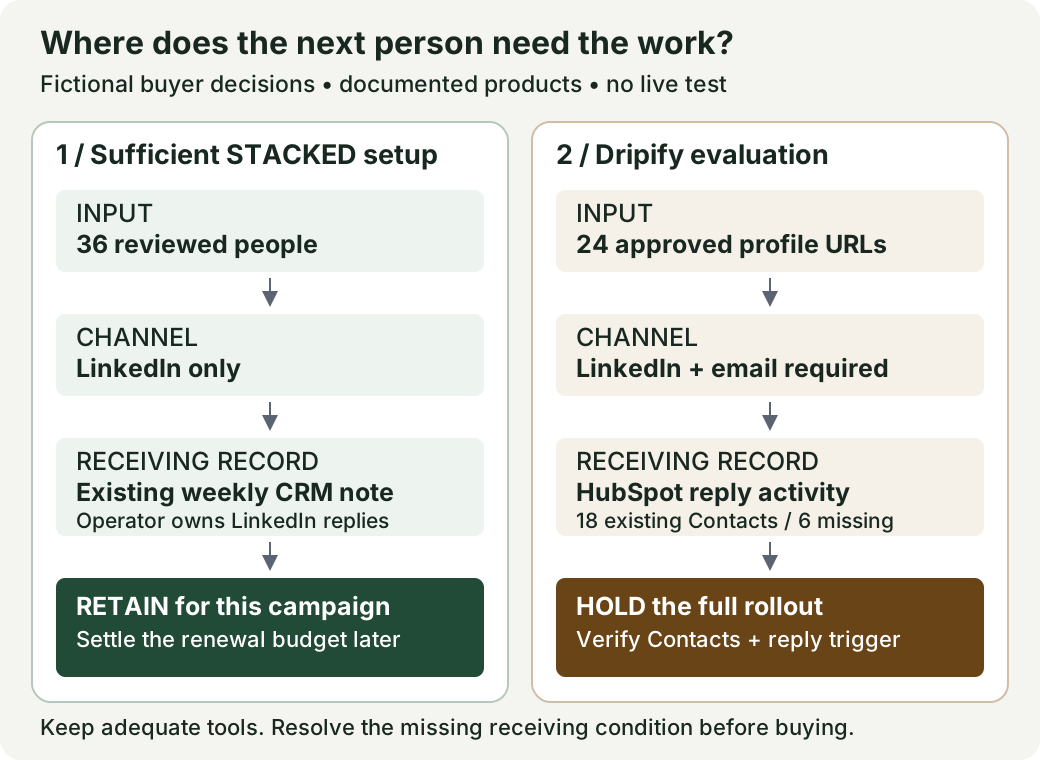
Fictional case. A specialist consulting practice has one LinkedIn operator, a reviewed list of 36 people and an existing STACKED Cloud licence. It uses LinkedIn for this campaign. A second colleague only needs a weekly account note in the practice’s CRM; no email sequence, automatic conversation archive or new shared login is required.
In the case assumptions, the operator already maintains those notes and exclusions successfully. The remaining 36 people are ready for individual review, and active conversations stay in the existing process. These are invented starting conditions, not an assertion that STACKED’s integrations have been tested by us.
The buyer sees Dripify Pro’s lower monthly USD reference and considers switching. The completed decision is retain STACKED Cloud for this campaign. There is no missing channel or receiving job. Reconstructing campaign state would create work without resolving a current requirement. The apparent subscription difference also says nothing about the unused period of the existing licence or the cost of reviewing transferred records.
The practice also considers Local. Assume its owner permits USD 70 monthly for this software, but the campaign must continue during days when the operator’s laptop is off. The Local headline fits that ceiling; the documented execution condition does not fit the requirement. Cloud’s monthly reference exceeds the ceiling. That is a budget conflict to settle, rather than a reason to pretend Local will continue while the laptop is off.
For the current paid period, the practice keeps its sufficient setup. At renewal, the owner can increase the allowance, deliberately restrict scheduled activity to available computer hours, or evaluate a different complete workflow. Each changes a real condition. None requires rebuilding the audience today.
The handover remains concrete: the operator owns LinkedIn replies; the colleague receives the agreed weekly account note; the existing records retain conversation and exclusion context. If that weekly note later becomes inadequate, the new requirement should name the missing record or deadline. “More automation” alone is too vague to justify a migration.
Case 2: required email and HubSpot activity create a purchase hold
Fictional case. A training provider already has 24 approved LinkedIn profile URLs. Its new campaign requires LinkedIn and email steps. A sales coordinator works in HubSpot and needs the LinkedIn reply conversation on the correct Contact before taking over. The permitted software budget is USD 100 monthly, excluding an existing HubSpot subscription and email mailbox.
This is a different decision from the first case: a weekly manual note is insufficient. Dripify Pro is a plausible candidate at its monthly reference, but the buyer’s required destination is more specific than “has HubSpot.” No additional profile purchase is needed to begin this evaluation.
Read the conflicting instructions before buying
The 6 October integration overview documents field mapping, campaign triggers and transferring a LinkedIn reply conversation into HubSpot Contact activity. However, the 25 September setup guide says the integration is in beta and updates existing Contacts only; new-contact creation is forthcoming. It also ties the Conversation field to a reply-received trigger, while its displayed trigger list omits that option. Treat the reply control as unresolved until checked in the intended account.
The setup guide describes matching by LinkedIn URL first, then email, then name, and says existing email addresses are not updated. That makes identity review consequential. The same-name fallback is a reason to check the receiving Contact, rather than assuming that a mapped field makes the identity correct.
Complete the buying decision with the actual receiving conditions
Under the fictional case assumptions, 18 of the 24 people already have reviewed HubSpot Contacts. Six do not. The proposed decision is hold a full rollout. The documented creation limit leaves those six without the required receiving record. The reply-trigger inconsistency also prevents a purchase decision based solely on the overview.
The coordinator prepares a narrowly defined check using an authorised internal test identity, its real LinkedIn URL and its already-existing HubSpot Contact. Required evidence is: the selected Contact identifier; mapped profile URL and company; the available campaign trigger; the reply conversation appearing as Contact activity; and visibility to the intended coordinator. Those are acceptance requirements authored for this case, not observations from a test we ran.
A “connected” banner or imported profile count does not complete that check. If the conversation lands only in a property, appears against the wrong Contact or cannot be seen by the coordinator, the mandatory job remains unfinished. Correct the mapping or control and repeat only the affected check before expanding.
For the six missing Contacts, the owner must separately choose an approved contact-creation process or obtain current evidence that creation is supported. Do not assume a CSV of profile URLs creates CRM Contacts. If the owner rejects an extra receiving process, this selected workflow remains unsuitable until that dependency changes.
If all conditions are later met, a limited Dripify evaluation becomes reasonable within the stated budget, subject to any extra address-finding or connector costs. If the existing STACKED integration already satisfies the same channel and record requirements, retain it instead. No claim here establishes that STACKED lacks an email solution, nor that either product completed this fictional test.
Do not buy another source to fix a receiving problem
Both products document native input routes. STACKED’s enrollment guide covers searches, files and clipboard URLs; its current CSV requires id, Profile and Degree, while TXT accepts one full profile URL per line. Dripify’s lead-addition guide covers searches, network, events and supplied URLs/CSV. Choose the supported contract for the real input. Do not invent connection degrees or identifiers to force compatibility.
Recurring input is a separate requirement. Dripify’s Evergreen guide describes post checks every 12 hours and Sales Navigator checks weekly, off by default, with a 10,000-lead list cap and collection paused with the campaign. Its September update limits Sales Navigator Evergreen to new campaigns created after release. Neither worked case needs that extra collection. Buying Advanced for a finite approved list would need another reason.
AI is likewise a task, not a tie-breaker by itself. STACKED advertises message personalization, a response assistant and MCP. Ask which action matters and who reviews it. No AI output comparison, approval guarantee or response-quality advantage has been established here.
When Leadsforlinked is a relevant comparison
If the unmet job is a LinkedIn campaign, a human-operated Inbox and an internal Kanban pipeline, review the normal Leadsforlinked paid platform. The published Starter catalogue is EUR 29 monthly for one connected LinkedIn account, campaigns, Inbox, Kanban and analytics. It does not establish native HubSpot sync, email sequencing or human-seat equivalence. That makes it a separate fit assessment, rather than the answer to the training provider’s unresolved requirement.
Only if profile input is missing, use the free profile-sample guide: 100 profiles once, no card, in batches of 20, with CSV export in the app. Inspect the actual people and fields. This allowance does not unlock paid campaigns or AI.
Evidence and limits
The linked official pages were checked on 7 November 2026. Prices and functions are advertised or documented; account availability, imports, sending, reply handling and CRM writes were not tested. Keep the HubSpot contradiction visible until resolved. LinkedIn’s automated-activity policy prohibits third-party scraping and automated website activity. Local or cloud deployment does not establish a comparative restriction rate or approval.
Frequently asked questions
Should I replace a working Dux-Soup setup with Dripify?
Only when a specific unmet requirement justifies it. Name the missing channel, receiving record or operating condition, then verify the selected workflow. Keep a sufficient setup and its context.
Does the Dripify HubSpot integration create new Contacts?
The setup guide checked on 7 November 2026 says its beta updates existing Contacts only. Treat new-contact creation and the inconsistent reply-trigger instructions as unresolved purchase conditions.
Is STACKED still just a Chrome extension?
No. Current STACKED is a desktop application with Local and Cloud execution options. Check the edition you use and its operating requirements.
Do I need a separate profile extractor for either product?
Not when a documented native input already provides the audience you need. A profile export cannot by itself repair a missing email step, conversation record or CRM receiving process.