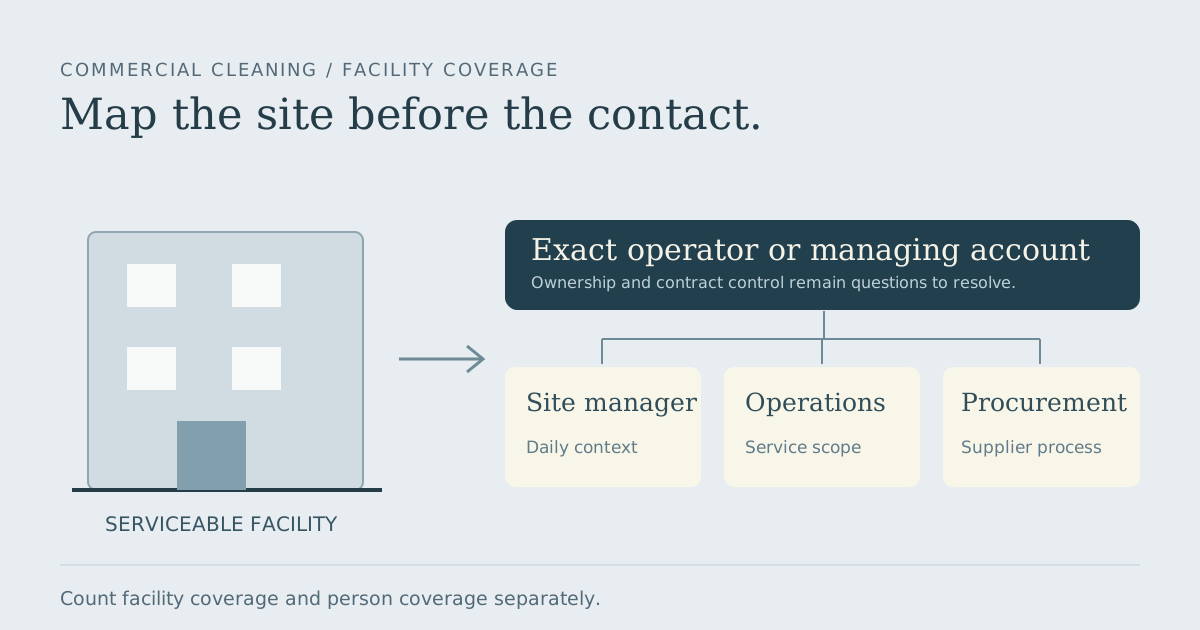
A commercial-cleaning prospect list starts with places your crews can serve. LinkedIn helps find the people attached to those places, but a person file can hide important gaps: the building has no named operator, a central procurement contact has no local site context, or an office manager does not own the cleaning contract. Build facility coverage first, then collect profiles for the roles that can explain or approve the work.
The aim is a reviewed research audience for a real territory and service scope. A LinkedIn title does not establish an open tender, a contract expiry or dissatisfaction with an incumbent. Keep those questions open while making the route to the right account clearer.
An April 2026 commercial-service sales discussion describes the original poster struggling to reach the person behind reception at offices and clinics. That is one reported access problem. The practical response here is to map site management and contract ownership, not to infer a response rate from replies or promise that a new contact list bypasses every gatekeeper.
Choose facilities that match your crew and service route
Write the facility types, delivery area and services your team accepts. Office cleaning, a clinic, a warehouse and specialist cleaning can involve different operating requirements. Keep services outside your capability out of the prospecting brief. A broad “commercial property” category is not enough to decide which sites you can quote and deliver.
Record the actual site address, facility label and evidence source. Person geography can help find local contacts, but it is not the building address. Company headquarters may be far from the operating site. LinkedIn's Sales Navigator definitions distinguish those location filters. Treat a location result as a starting point for facility research.
For a portfolio, list each site or the exact subset in your service area. Do not label a national property account “covered” because you found one executive. Hold a facility when its geography or service type is unknown. A deliberate service boundary keeps the list connected to crew planning rather than rewarding extra contacts you cannot serve.
Separate owner, occupier, operator and property manager
The building owner may appoint a managing agent. An occupier may control only its own office cleaning. A facilities contractor may manage several suppliers, and a central group may buy for multiple locations. These are possible operating arrangements to investigate, not assumptions about a particular building. Record which organization your next conversation should concern.
Use the site's own information, the operator's portfolio and current company evidence to connect people to the facility. Keep both the property name and the company account in the file. If two observations disagree about the operator, retain the conflict and assign a reviewer. Replacing one with the more familiar brand can send the conversation to the wrong organization.
A useful opening research question is: “Who manages cleaning for this site, and is the supplier decision local or central?” It is more precise than assuming an office manager signs every contract. The answer can redirect the next step without requiring you to discard the site or guess the chain of responsibility.
Cover practical operations and procurement separately
| Lane | Roles to investigate | Useful question |
|---|---|---|
| Site management | Property, building, office or practice manager | Who sees daily service issues and knows the site's requirements? |
| Operations | Facilities or regional operations manager | Who defines access, scheduling and service scope? |
| Procurement | Vendor, procurement or contracts role | Who controls supplier review and the commercial process? |
Keep the role lane with each observation. A procurement person can be useful without covering day-to-day site operations. A facilities manager can explain the requirement without owning the supplier decision. You may need more than one person at an account, but that should reflect an actual coverage gap. Avoid exporting every employee simply because the company is relevant.
Track a facility as “research coverage complete” only under your own rule. For one site that might mean a confirmed operator and one management contact; for a portfolio it may require local operations and central procurement. Use the worksheet to make the rule visible. Meeting the research rule still leaves contract timing and commercial qualification open.
Find profiles linked to the selected operators
LinkedIn's People search offers Current company and Locations filters. Start with the operator account and a role lane, then inspect current profiles. For exact role phrases, Boolean search supports quotes and uppercase operators. Natural-language search is a separate mode without quotes. Keep your query with the source notes so another researcher can repeat the selection.
If your team already has Sales Navigator, current company, current job title and account-list filters can narrow the selected operators. A property manager's post or an event discussion may offer useful context, but participation does not prove that person has a cleaning need. Prefer a source that supplies your intended account-role audience over a large unrelated activity list.
When exporting selected profiles, inspect the actual identifiers and fields. Keep a site/account key outside the person identity so central contacts can relate to several facilities without being sent several times. Preserve unresolved opaque values for review. Use the selected-company contact guide for account sourcing and existing-reference exclusion before creating a new-account payload.
Use the original practice pack and blank brief
Download the blank sourcing worksheet
The worksheet records your actual requirements, source evidence, exported fields, accepted and held counts, remaining gap, owner and review date. Fill it before ordering a larger audience. Practice with the ten fictional raw observations, complete decisions and instructions. Every original cell remains available. These teaching records are synthetic and do not contact; do not upload them to a vendor.
The fictional cleaning brief accepts a serviceable commercial site, a confirmed operator and a relevant person lane. C01 supplies a property manager, C02 an operations contact and C10 procurement coverage for C01's site. C03 has an unresolved operator, C04 lacks actual site geography, C05 has no current role and C06 has an opaque identity. C07 is outside the crew route, C08 is residential and C09 is already handled as an existing account.
| Research candidates | Held for review | Rejected for this brief |
|---|---|---|
| 3: C01, C02, C10 | 4: C03–C06 | 3: C07–C09 |
Inspect the separate accepted research subset and held observations. Rejected originals remain in the full decisions file. For your real list, keep unknowns held and approve a separate payload only after the relevant evidence is complete. The teaching headers are not an asserted product export schema.
Measure the remaining facility and person coverage
Test Leadsforlinked with 100 free signup profile leads, in batches of 20, without a card. Review a batch against your selected operators and role lanes. Record how many actual facilities gained useful research coverage and which people were accepted. An exported contact count cannot answer the facility-coverage question on its own.
Choose your final facility audience and the missing role lanes. Subtract already approved people and actual accepted sample people from that chosen job; leave unresolved holds out until reviewed. The remaining-job offer planner and profile-input purchase guide compares the eligible once-only 500-profile offer at €1.99 with Basic at €4.99 monthly or €35.88 for the full year, equivalent to €2.99 monthly. Keep the once-only offer separate from recurring extraction.
Buy more profile input when it fills the reviewed facility audience, rather than increasing duplicate contacts at buildings you already cover. If the sample mostly returns the wrong operator or distant sites, repair the account mapping first. Add email or phone enrichment only when the chosen conversation route needs it; a profile export is not a verified call list.
Hand the accepted audience to the person responsible for sales with its site evidence, operator mapping, role lane and next question. Keep held sites visible for research and existing accounts assigned to their current owner. That produces a practical territory file that can support quoting and conversations without inventing a contract opportunity.
Frequently asked questions
Is a property owner always the cleaning-contract buyer?
No. Investigate the site operator, managing agent, occupier and supplier process. Keep the exact organization and role responsible for the site in your research notes.
Should I count contacts or facilities?
Track both. A central contact may cover several sites, while several contacts may serve one site. Your brief should define facility coverage and the role lanes still missing.
Does LinkedIn activity prove a cleaning need?
No. Use profiles and activity for research context. Supplier timing, dissatisfaction and buying authority need confirmation in the actual sales process.