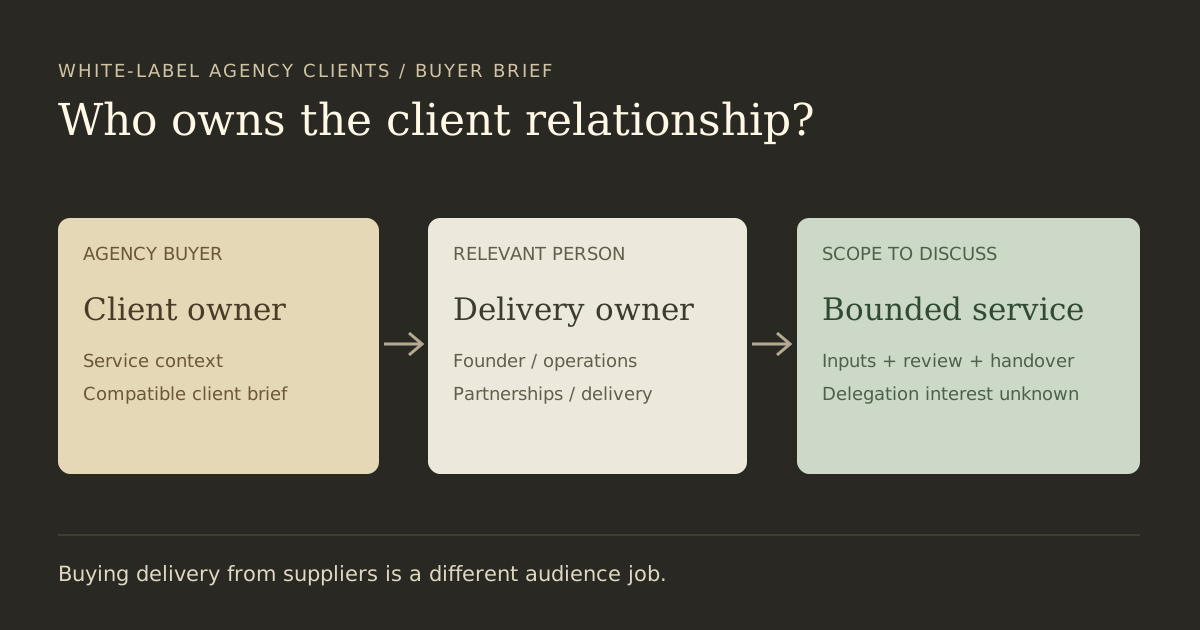
Finding white-label agency clients on LinkedIn means finding agencies that could buy your delivery work while keeping their own client relationship. That is a different audience from agencies advertising white-label services as suppliers. Start with one service you can deliver, a type of client-owning agency that might use it, and the people who own delivery or partner relationships.
Your prospect list should identify plausible agency buyers for a conversation. It should not label them as overloaded, outsourcing or ready to purchase because they posted a job, gained clients or use a particular title. Capacity, willingness to delegate and a live brief need confirmation with the agency.
In a 2026 new-agency discussion, a developer describes work delivered under another brand and asks how to find clients; later the original poster asks what an agency looks for when handing off white-label work. Another agency buyer discussion asks for case studies after a poor provider experience. Those individual questions support a more precise buyer and delivery brief, not a claim that every agency needs a subcontractor.
Choose one delegated service your agency can own
Write a delivery promise with a clear boundary: the type of work, what the buyer supplies, what you return, and how the buyer reviews it. A broad list of websites, software, automation and marketing makes it hard to identify the agency with a matching service gap. Begin with the service for which you can show relevant work and explain a repeatable process.
For example, a development team could research branding agencies that own client strategy and may need a delivery partner for a defined website build. The buyer brief should state the stack, handover material, review stages and support boundary. Those are examples to adapt, not evidence that a named branding agency outsources its development.
Keep your available capacity, minimum sensible project and communication expectations in your own brief. The client-facing agency needs to understand what it can delegate without promising work you cannot deliver. Useful proof can include a permitted case study, a walkthrough of your role and a clearly bounded sample of deliverables. Do not imply permission to name a past client when your agreement does not allow it.
Look for client-owning agencies, then classify the lane
Research agency accounts whose public positioning and portfolio fit the service you want to deliver. Record what the agency sells to its clients, the industries it serves and the evidence behind that observation. A portfolio establishes some service context; it does not establish an available budget or an outsourcing policy. Keep “delegation interest” as an open field.
| Observed lane | How to treat it | Question to resolve |
|---|---|---|
| Client-facing agency with relevant services | Research buyer candidate | Does it delegate this delivery work, and who owns the brief? |
| Explicit supplier-only white-label provider | Outside this buyer brief | Use a supplier-vetting list if you want to purchase delivery |
| Agency with unclear client ownership | Hold for account research | Does it originate the client relationship or deliver for others? |
| Direct end business | Separate direct-client audience | Does your direct-client offer fit instead? |
Some agencies can be both buyers and suppliers. Do not exclude one simply because the phrase “white label” appears on its website. Classify the actual relationship you are researching. The fictional exercise excludes a supplier-only case because that brief explicitly requires a client-owning buyer; it does not turn the wording into a universal rule.
Choose a coherent segment before broadening. A design agency selling to local professional businesses and a large marketing network may require very different delivery, procurement and account-management arrangements. Keep them in separate sourcing briefs if the way you work with them differs. More accounts are useful only when the offer can fit them.
Find the person who can discuss delegated delivery
At a small agency, the founder may own client relationships and delivery. At another, a delivery director, operations head, technical lead or partnerships manager may own part of the decision. These are research roles to investigate. Record why a person's current responsibility matches your proposed service rather than calling every senior title a buyer.
A client-facing account lead can explain client requirements but may not approve a new supplier. A partnerships role may introduce you to delivery without defining the scope. Your first useful question is who reviews external delivery for the particular service. Keeping those responsibilities separate makes the next conversation easier to route.
Prepare a short discussion brief: the work you can own, one relevant proof point, what you need from the agency, what stays with its team and who handles review. Ask whether the service fits its delivery model. Avoid a message that assumes the agency is short-staffed or tells it you know its client pipeline. The profile source cannot establish those facts.
Source the selected agency accounts and roles
Use the agency's own service and portfolio evidence to build the account shortlist. On LinkedIn, People search includes Current company and role/location details. For a precise role phrase, the documented Boolean route uses quoted phrases and uppercase operators; natural-language search is a separate mode without quotes. Search one agency-role lane first so you can see whether the wording returns the people you need.
Sales Navigator's current-company, current-job-title and account-list filters can support the same account-first approach when you already have access. Geography can help plan communication, but it does not establish timezone availability, language fluency or a contractual working arrangement. Keep those topics in the delivery conversation.
For a larger selected audience, inspect actual exported identities and role fields before handing it to sales. Preserve original source context and hold unresolved opaque identifiers. Compare against active opportunities and existing agency clients so the new file does not create duplicate conversations. The agency sample-approval guide provides a broader handoff process, and the existing-reference guide helps separate current relationships.
Use the original practice pack and blank brief
Download the blank sourcing worksheet
The worksheet records your actual requirements, source evidence, exported fields, accepted and held counts, remaining gap, owner and review date. Fill it before ordering a larger audience. Practice with the ten fictional raw observations, complete decisions and instructions. Every original cell remains available. These teaching records are synthetic and do not contact; do not upload them to a vendor.
The fictional brief seeks client-owning agency buyer candidates for web delivery. W01, W02 and W10 have the required account context and relevant founder, delivery or partnership role; all three still have UNKNOWN delegation status. W03 lacks client-ownership evidence, W04 has unclear service fit, W05 lacks a role and W06 has an opaque identity. W07 is explicitly supplier-only, W08 is a direct end business and W09 is already an active opportunity.
| Research candidates | Held for review | Rejected for this brief |
|---|---|---|
| 3: W01, W02, W10 | 4: W03–W06 | 3: W07–W09 |
Inspect the separate accepted research subset and held observations. Rejected originals remain in the full decisions file. For your real list, keep unknowns held and approve a separate payload only after the relevant evidence is complete. The teaching headers are not an asserted product export schema.
Turn the sample into a larger buyer-audience decision
Test the selected agency source with Leadsforlinked's 100 free signup profile leads, in batches of 20, without a credit card. Review one actual batch for client-owning account fit, the relevant person role and the stated service lane. Record approved agency accounts and accepted people separately. Keep delegation status unknown until discussed; accepting a research candidate is not confirming a purchase.
Choose the final agency and role coverage for your buyer job. Subtract current approved people and the actual accepted sample from that coverage, while keeping unresolved holds available. Use the remaining-job offer planner with your own profile-input requirement. It helps compare the chosen billing horizon rather than forecasting clients or revenue.
The published offers are an eligible once-only 500 profiles for €1.99, Basic at €4.99 monthly, or €35.88 for the full year at €2.99 effective monthly. The once-only offer is not a recurring pack. A repeatable agency-buyer sourcing job may justify recurring extraction, while a single reviewed audience may need a different commitment. Retain later contact enrichment or sending tools if your workflow requires them.
For the final handoff, include the agency's service evidence, accepted roles, your bounded delivery offer, the open delegation question and the relationship owner. A serious next step could be a scoped discussion of client access, review, confidentiality, commercial terms and a small actual brief. Those agreements happen with the agency; they are not properties of the exported list.
Frequently asked questions
Are white-label suppliers the same audience as agency clients?
No. This buyer brief seeks client-owning agencies that could purchase delegated delivery. Supplier-only accounts belong in a different purchasing job; some agencies can occupy both lanes.
Does a hiring post prove an agency wants to outsource?
No. Use public service and role evidence to select a research candidate, then ask about the agency’s delivery model and actual brief. Do not assume capacity pressure or buying intent.
What should I show an agency buyer?
A bounded service offer, permitted relevant proof, clear inputs and outputs, and a review process. Client access, confidentiality and commercial terms remain topics to agree directly.