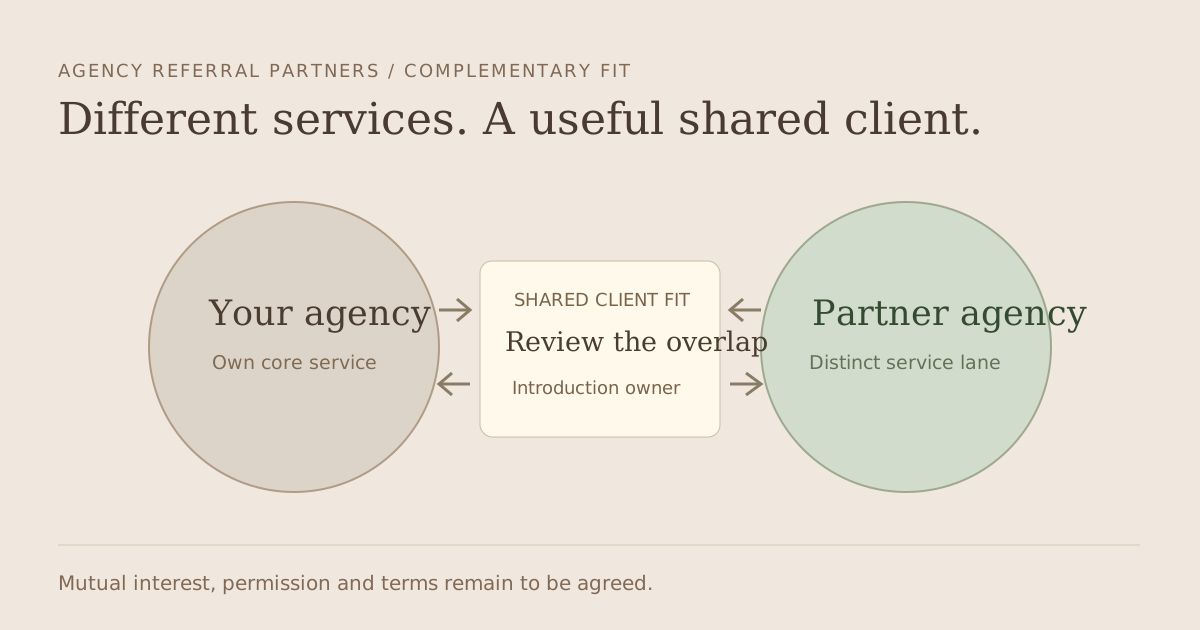
An agency referral partner prospect list should explain why each agency belongs beside your own. Start with the client problem you solve, then look for agencies that serve compatible clients and add a different service. A large agency directory is less useful if the services compete, the client segments differ or nobody owns the introduction process.
The list is an audience for exploring a partnership. It does not establish mutual interest, a referral agreement or permission to share client information. Keep those questions open while making the proposed service relationship specific enough for an agency owner to assess.
A 2026 agency partner request describes seeking agencies that add value around a defined client segment and services outside the poster's own scope. Another 2026 SEO agency discussion asks about building reciprocal relationships with specialized agencies. These individual requests show the value of a clear service boundary. Use them to refine the fit questions rather than predict a partnership outcome.
Define what your agency owns and what it does not
Write your core services and the client situations you handle well. Then record the adjacent requests you prefer to refer out. For a development agency, that could include brand strategy, SEO strategy or paid-media work when those are outside its delivery offer. Another agency will draw the boundary differently. Use your actual service scope rather than a generic list of profitable partner types.
State the client segment, geography and project shape that make an introduction useful. A partner can offer a different service but still serve a very different customer. Sharing an industry label is not enough if one agency works with large procurement teams and the other handles owner-led local businesses. Keep the actual client fit visible in the brief.
Decide which relationships you are trying to add: a complementary referral source, a destination for out-of-scope work, or a reciprocal relationship. Do not combine those with a white-label delivery purchase. If your aim is to sell subcontracted work to agency buyers, use the separate white-label buyer sourcing guide.
Choose complementary lanes and review core overlap
| Partner lane | Possible shared client work | Overlap question |
|---|---|---|
| Brand strategy agency | Brand direction before a website build | Does either team claim the same development scope? |
| SEO strategy agency | Search requirements and technical implementation | Who owns strategy, implementation and reporting? |
| Paid-media agency | Landing-page delivery around campaign requirements | Who controls campaign management and ongoing changes? |
The table is a planning example, not an assertion that these lanes automatically work together. Check each agency's current service positioning and public client context. A “full-service” agency might have substantial overlap or might welcome a specialist. Hold the case until the scope is clear rather than rejecting or accepting it from the label alone.
Use explicit exclusions. You might exclude a direct competitor for the same core work, an unrelated consumer audience and agencies already in your partner program. Do not claim that competitors can never refer business; this particular brief simply selects complementary relationships. If you want a different model, document that rule in a separate audience job.
Keep a field for the proposed value in each direction. “They could send us clients” is one-sided. A more useful fit note explains the client situation you could pass to them and the work they could pass to you. A speculative idea remains a proposal until both agencies confirm how they would handle it.
Find the people who own introductions
At a small agency, an owner or founder may manage relationships. Another agency may have a partnerships lead, business-development director or client-services leader. Record the relevant responsibility, not just seniority. A specialist can be useful for technical research while lacking authority to agree a referral process.
Prepare questions about shared client fit, service boundaries and how each side wants an introduction made. Ask who should receive it and what information can be shared with the client's permission. Keep fee, attribution and commercial arrangements as terms to discuss; a prospect list should not silently create them.
A useful proposal can describe one client scenario where your services complement theirs, then ask whether that type of relationship is relevant. Avoid assuming their pipeline is weak or presenting a fixed number of referrals as the value. The stronger basis is a concrete problem both agencies can route responsibly.
Build an account-first LinkedIn audience
Review agency service pages and permitted public case studies to create the account shortlist. Use LinkedIn People search with Current company and a relevant role to find relationship owners. Role, company and location details can also appear in a natural-language query. For exact phrase logic, Boolean search uses quotes and uppercase operators; keep the two modes separate.
If you already have Sales Navigator, account-list and current-title filters can connect the person search to the approved agency segment. A mutual connection can provide context, but it is not consent to contact their clients or a promise to introduce you. Keep the account's service evidence and the actual person role with each observation.
When you need a portable selected-profile audience, inspect the actual export for public person identity and current role. Preserve raw source context and hold opaque identifiers without inventing public slugs. Exclude active partners and ongoing conversations using a reviewed reference. The existing-contact exclusion guide is useful when a reference contains incomplete identities.
Count unique agency accounts as well as people. Several contacts at one agency can help resolve introduction ownership; they do not create several independent partner relationships. Keep the unresolved owner or overlap question on the account so another researcher can continue the work without repeating the same search.
Use the original practice pack and blank brief
Download the blank sourcing worksheet
The worksheet records your actual requirements, source evidence, exported fields, accepted and held counts, remaining gap, owner and review date. Fill it before ordering a larger audience. Practice with the ten fictional raw observations, complete decisions and instructions. Every original cell remains available. These teaching records are synthetic and do not contact; do not upload them to a vendor.
The fictional brief belongs to a development agency seeking complementary services. P01, P02 and P10 have shared client fit, distinct service lanes and an introduction owner; their relationship status remains UNCONFIRMED. P03 has unresolved core overlap, P04 lacks client-fit evidence, P05 lacks introduction ownership and P06 has an opaque person identity. P07 is a direct core competitor excluded by this brief, P08 serves a different client audience and P09 is already an active partner.
| Research candidates | Held for review | Rejected for this brief |
|---|---|---|
| 3: P01, P02, P10 | 4: P03–P06 | 3: P07–P09 |
Inspect the separate accepted research subset and held observations. Rejected originals remain in the full decisions file. For your real list, keep unknowns held and approve a separate payload only after the relevant evidence is complete. The teaching headers are not an asserted product export schema.
Use the sample to define the remaining partner audience
Start a selected-profile test with Leadsforlinked's 100 free signup profile leads, in batches of 20, without a card. Review one batch against your complementary service lanes, shared client brief and relationship-owner rule. Separate accepted research candidates from agencies that require further overlap or role clarification. Do not treat either group as signed partners.
Choose the final agency coverage and the person roles required for this relationship job. Subtract already approved people and the actual sample's accepted people, then keep held cases outside the remaining-job arithmetic until reviewed. Enter your own profile-input requirement in the offer planner. It compares purchase commitments rather than estimating referrals.
The eligible once-only offer supplies 500 profiles for €1.99. Basic is €4.99 monthly or €35.88 for the full year at €2.99 effective monthly. Treat that once-only offer separately from a repeat sourcing program. Buy additional profile input only when the sample fits and the larger job still has a defined account-role gap.
Hand over the accepted audience with a fit note, the proposed value in each direction, current owner and open questions. A subsequent conversation can establish mutual interest, permission, attribution and terms. Keep a record of agreed partners separately from research candidates so your next audience refresh adds relationships instead of creating duplicate proposals.
Frequently asked questions
What makes an agency a referral partner candidate?
A compatible client segment, a complementary service boundary and a person who can discuss introductions. Mutual interest, permissions and terms still need agreement.
Should I exclude every full-service agency?
No. Review its actual service scope. Hold unresolved core overlap and use your brief to decide whether the proposed relationship is complementary.
Is a referral partner list the same as a white-label buyer list?
No. A referral audience explores introductions between separate providers. A white-label buyer audience seeks client-owning agencies that could buy delegated delivery. Keep the commercial jobs distinct.