Choose a LinkedIn automation runner by the conditions required at the moment an action becomes due. A local runner can depend on your device and session; a cloud runner moves some execution work to a supplier. Neither description, by itself, tells you what happens after authentication expires, a reply arrives or the person responsible for answering is unavailable.
The buying question is practical: can the proposed subscription operate within your working schedule, expose interrupted work and let you resume without repeating an uncertain action? This guide uses a fictional Friday-to-Monday timeline to make that decision. It does not report a product run, a reliability benchmark or a safe level of LinkedIn automation.
Separate the editor, runner and reply owner
The screen where you prepare a campaign is not necessarily the process that executes it. A browser can edit a cloud-managed sequence, while a desktop application can have local and cloud modes. Ask where each action runs rather than classify a product from the presence of an extension or an app download.
For a device-dependent route, establish which application or browser profile must remain running, whether the device needs to stay awake and connected, and how interruption appears. For a supplier-managed route, establish which session remains valid, how a loss of authentication is reported and who must restore it. Keep the human operator as another dependency: a working runner does not answer a buying question on your behalf.
The existing multi-step campaign guide owns sequence design, audience enrollment and reply checks. This page owns the purchase decision about execution conditions. It does not add a new recipe for building the branches or turn a visible condition block into tested cancellation behavior.
Read the current product mode, not an old category label
On 7 November 2026, an older Cloud Dux help address redirected to Dux-Soup's current “Why choose STACKED cloud?” page. It describes managed cloud infrastructure and says campaigns can continue with the application closed or the computer switched off. That is a specific supplier's documented mode, not a claim about every cloud product or Leadsforlinked.
The same supplier's session guidance describes local LinkedIn-session changes invalidating cloud authentication and interrupting the cloud instance. Read these sources together: removing the need for an awake laptop does not remove authentication dependencies. No STACKED session, interruption or recovery was tested for this article.
Compare the exact offered mode and its current instructions. An old reference to a Turbo extension is not enough to specify today's cloud purchase. Similarly, the word “cloud” does not establish an uptime commitment, a retry policy, a guaranteed send time or automatic recovery. Obtain those answers for the actual subscription under consideration.
Use four states that distinguish a plan from an event
Scheduled means an action is intended for a time or condition. Attempted means the runner reports trying it. Confirmed means the available evidence establishes the particular completed action your process needs. Held means it should not proceed until a stated question is resolved. These are this guide's review labels, not asserted product status names.
A scheduled message is not a delivered message. An attempt with an uncertain result also differs from a confirmed failure. Before a retry, inspect the current conversation and the supplier's activity evidence so the same action is not repeated merely because the screen was slow.
Record the action, sender, intended recipient reference, planned time, available event evidence and next owner. Keep the timezone explicit. When two products expose different event labels, compare their meaning rather than assume matching colours or success icons establish equivalent outcomes.
Work through a Friday-to-Monday interruption
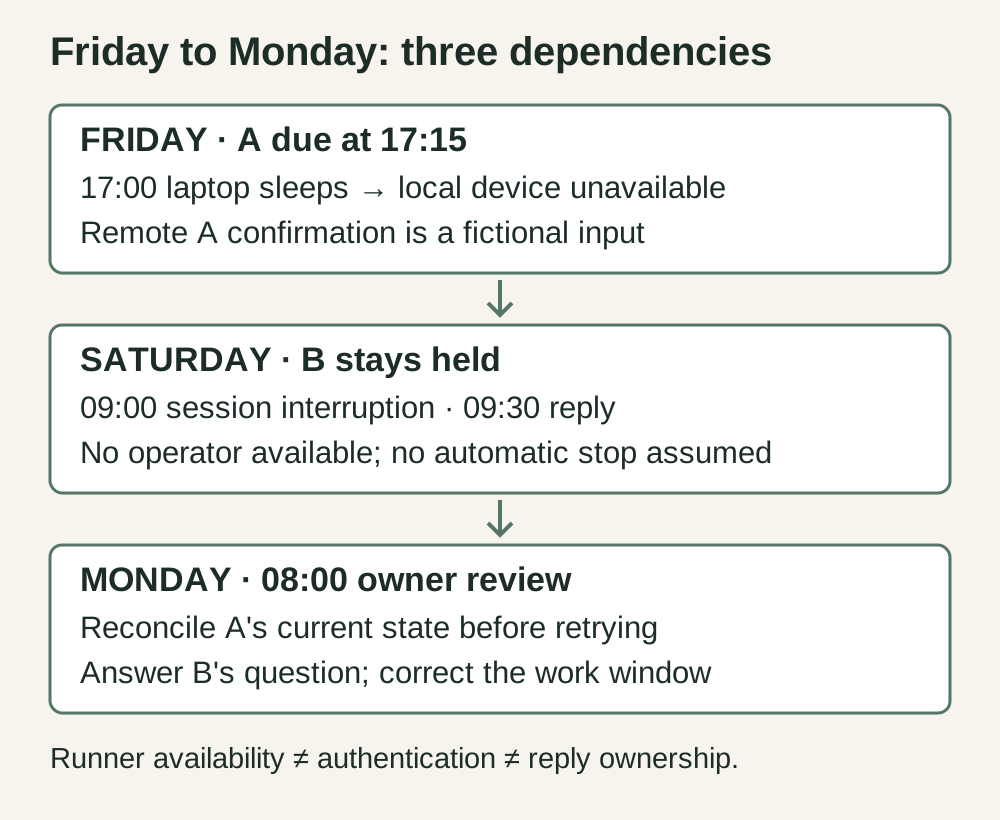
The people, times and events below are invented. Two follow-ups, A and B, concern existing connections in an approved fictional audience. There are no real recipients or sends. The comparison stipulates two possible execution arrangements: one requires the laptop to remain available, and the other has a supplier-managed runner. Neither is identified as Leadsforlinked.
The operator can review replies until Friday 17:30 Europe/Paris, then returns Monday at 08:00. Follow-up A is scheduled for Friday 17:15. B was incorrectly left scheduled for Saturday 10:00, outside the team's intended operating window. The case's policy is to hold an inappropriate follow-up after a reply and have the named operator answer the actual question.
| Time and event | Device-dependent arrangement | Supplier-managed arrangement | Owner's decision |
|---|---|---|---|
| Friday 17:00 · laptop sleeps | The required device is unavailable. | The stipulated remote runner remains available. | Inspect A's execution evidence; a due time alone establishes no send. |
| Friday 17:15 · A becomes due | No attempt is established in the supplied case. | The case supplies an attempt and a confirmation for A. | Keep the two outcomes distinct. Do not retry the confirmed A action. |
| Saturday 09:00 · required session expires | Execution remains unavailable. | The stipulated runner reports an authentication interruption. | Hold dependent work until the authorized owner resolves the session. |
| Saturday 09:30 · B's recipient asks a question | The old follow-up is no longer the right next action. | Cloud execution would not resolve the question either. | Retain the reply; hold B's pitch under the case policy. No automatic suppression is assumed. |
| Monday 08:00 · operator returns | Review A's uncertain state before deciding whether it still belongs. | A stays confirmed; review the interruption and current conversation. | Answer B's question, correct the working window and reconcile any remaining queue before resuming. |
There are two planned actions, not a measured completion rate. In one stipulated arrangement, A has no established attempt; in the other, A has a confirmed action. B remains held in both. The operator owes a human response to B. The comparison does not assume that reconnecting a session clears old actions, prevents duplicates or answers the reply.
Make the buying decision from the actual gap
If Friday's 17:15 action is necessary while the laptop must be closed, a route that requires that laptop cannot meet the stated execution requirement. A documented supplier-managed mode becomes a candidate. It still needs an acceptable authentication, interruption and recovery contract. The fictional cloud outcome is not proof that a vendor will reproduce it.
Saturday's B action exposes a different problem: the team has no reply coverage and its configured schedule contradicts its intended window. Buying a runner capable of working all weekend does not repair that policy. Correct the schedule or arrange actual coverage before adding unattended hours.
Keep the local option when it fits. A consultant who intentionally runs a short campaign during staffed desk hours may not need overnight execution. If an existing approved sender already meets those conditions, another subscription can be unnecessary. The useful comparison is the job and remaining dependency, not a universal cloud winner.
Ask what happens to the queue after an interruption
Ask the supplier whether a missed action is skipped, rescheduled, left pending or retried, and which evidence lets the operator distinguish those cases. Ask whether restored authentication automatically releases work, and how to inspect a queue before that release. Do not fill a missing answer with the behavior you would prefer.
Use approved fictional records for a permitted evaluation. Examine device interruption, session loss and an uncertain action result without contacting real prospects. Keep each test's actual environment, time, settings and output. A documentation answer is useful evidence, but it should remain labelled as documentation until the relevant behavior is observed.
If an action may already have happened, recovery starts with reconciliation rather than another launch. If the person has replied, the next decision comes from that conversation. Restoring a runner is a technical step; deciding that a message remains appropriate is an operational one.
What Leadsforlinked's current offer establishes
The Leadsforlinked outreach-platform page advertises Starter at €29 per month on monthly billing for one connected LinkedIn account, with campaigns, follow-ups, Inbox, Kanban and analytics. That is the relevant paid route for a one-account campaign and human-reply job. The free profile-CSV allowance is a different offer.
The source reviewed for this article does not establish where Leadsforlinked's campaign runner executes, whether a computer can be switched off, what session recovery does, how missed actions are retried or whether every queued follow-up stops on reply. Keep those cells unknown until the supplier supplies current evidence for your selected setup. A campaign-builder capture establishes none of them.
If the paid job fits, review the platform description and its existing Starter billing route. Confirm the chosen plan, authentication continuity and current terms before committing. No checkout or payment was tested here. If the runner requirement is essential and remains unresolved, hold that purchase rather than infer a cloud promise from the subscription name.
Finally, execution location does not establish platform permission. LinkedIn's automated-activity guidance restricts third-party automation. Local and cloud labels supply no safe-send quota or protection guarantee. Choose the supported workflow with its actual constraints visible.