Send a small pack that helps them make one decision. If the conversation has not established a task, give them a simple choice rather than sending your entire website.
Choose the decision before the attachment
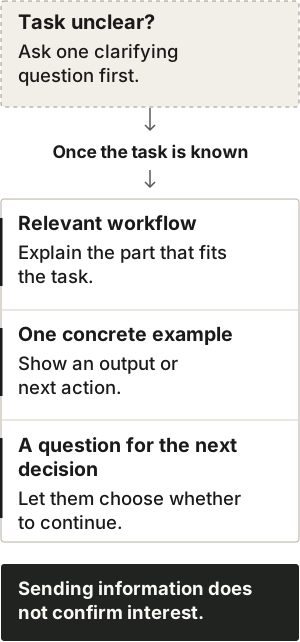
Read the last two messages. Did the prospect ask about finding suitable companies, organising outreach, managing replies, or something else? Write that task at the top of your note. If none is clear, say: “Happy to. Is your priority finding the right people, or keeping outreach and follow-up organised?” Their answer determines the material.
For a known task, use three pieces:
- A short explanation of the relevant workflow.
- One concrete example of the output or next action.
- A question that lets them decide whether to continue.
The pack can be a paragraph and a link. It does not need to become a designed PDF.
A useful information reply
A completed example
Fictional situation: a facilities consultancy says it wants a more organised way to approach operations directors. Its founder asks for information about Leadsforlinked.
A useful reply would be:
Here’s the relevant part: Leadsforlinked brings prospect targeting, LinkedIn outreach, conversations and follow-up into one workflow. For your operations-director campaign, the first job would be to agree which companies qualify, then review the contacts and messages before starting. I’ve linked the current plan details below. Would you be assessing this for your own sales activity or for a client assignment?
This answers the request without pretending that the consultancy has already approved a campaign. The question matters because responsibility, access and buying scope may differ.
If the prospect instead needs a CRM integration you have not established, the next step is checking that requirement. A generic product page does not answer a specific connection question.
Make the link earn its place
Introduce every link with its purpose: “current plan scope,” “example field structure,” or “a guide to planning a sequence.” Send one or two relevant links, then stop. Avoid an unexplained bundle of homepage, calendar, case study, video and checkout.
Salesforce’s consultative-selling guidance treats the buyer’s goals as the basis for a recommendation. Here, that means selecting information around the actual job rather than delivering every feature.
Decide what happens after sending
Record “information sent” separately from “interested.” The useful next event is the prospect choosing a task, raising a requirement, declining, or agreeing a next step.
If they do not respond, follow only the timing and contact arrangements already agreed. An information request is not permission for an endless sequence.
For Leadsforlinked, check the current offer against the task. Extraction-only work and an ongoing outreach workflow may need different plans. Let that distinction help the buyer choose rather than become another feature list.