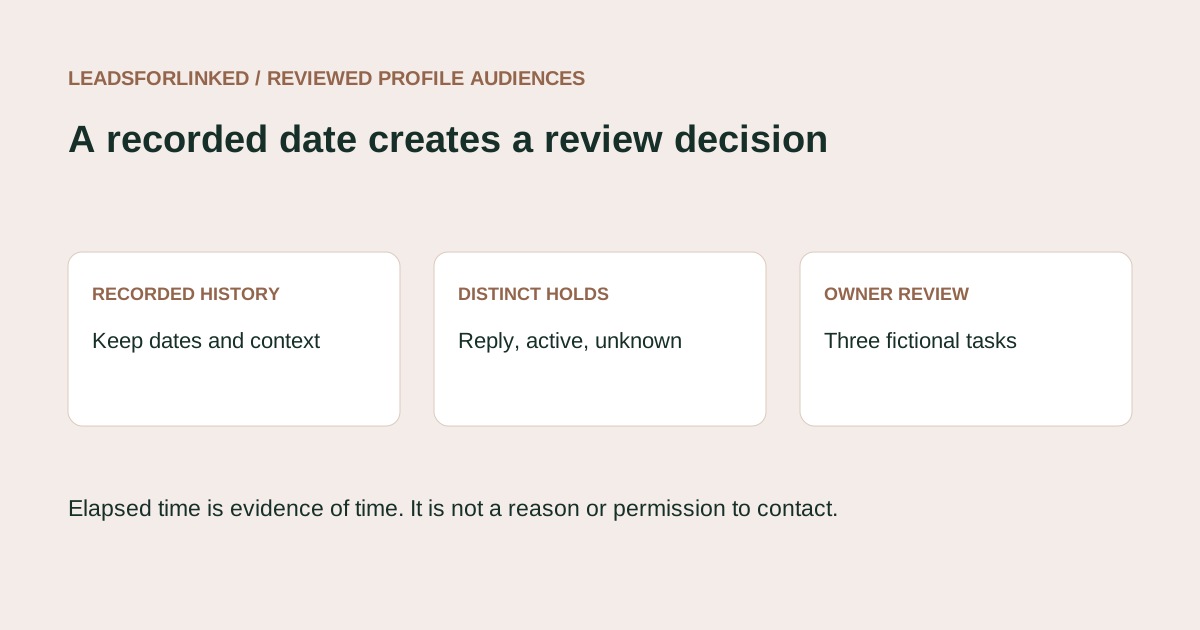
A LinkedIn recontact list is useful when it gives an owner the right records to review, with the last conversation and next step still understandable. An old date does not explain why another message would help. The deliverable is a dated review queue, alongside distinct holds for records that need a different decision.
Use the CRM or campaign view you already have when it contains the necessary history, owners and current profile context. Exporting that view may be enough. Additional profile sourcing belongs in the workflow only when useful current identity or role information is missing, or when a separate accepted audience must be filled.
Choose the recorded date that answers the question
Current HubSpot contact-property guidance distinguishes Last contacted from Last activity and Last modified. Last contacted represents logged external activities, including manually entered LinkedIn messages. Last activity also includes notes and completed tasks; Last modified records property changes. They do not all mean the same conversation happened.
Check the actual source field and its logged-channel coverage. A LinkedIn message outside the CRM's logging process may not appear there. A manually reviewed record can have a recent modification date without any recent conversation. Keep those distinctions in the blank recontact decision worksheet.
HubSpot's record export documentation describes current properties and associations, with separate routes for activities. Preserve the export scope, date, filters and source record identifier. A property snapshot should not be treated as a complete conversation archive.
Pair a next-step date with a business reason
A June 2026 firsthand sales discussion asks how often and for how long to follow up after pain, pitch and price. A later reply separates elapsed time from a reason to contact. The useful lesson for this queue is to retain an agreed next step, an open question or another specific business reason, rather than invent a universal interval.
Record a next-review date and the owner who understands its meaning. An agreed planning window differs from an arbitrary “not contacted recently” filter. If the record has no reason beyond elapsed days, send it to review before making it part of another outreach flow. A date threshold chosen for one team is not a permission rule for everyone.
Use a consistent date interpretation. Check the source timezone, whether the value records an actual contact or a planned activity, and whether it is a timestamp or a date-only value. A future last-contact date, a malformed value and a blank date need different corrections. Do not substitute the export date as a convenient last-contact value.
Keep four important history decisions separate
| Observed record | Queue handling | Owner question |
|---|---|---|
| Recorded do-not-contact | Separate suppression record | Which identity and instruction must remain protected? |
| Reply already recorded | Hold for the existing owner | What response or agreed next action belongs to this conversation? |
| Active conversation | Keep out of a parallel recontact flow | Who currently owns it and what is already scheduled? |
| Unknown last-contact date | Hold for history review | Is the history unlogged, omitted by export or genuinely unavailable? |
Suppression has priority over a due date. A reply is not automatically positive interest, and an active conversation is not a new introduction opportunity. Keep the owner's context available instead of flattening all these records into a single “contacted before” group.
These holds do not mean that every record is permanently unusable. They explain which decision is missing and who should make it. Date-unknown records need history evidence; a reply needs its owner; an active conversation needs coordination. That is more useful than hiding them behind a generic age filter.
Check identity and current responsibility
Keep the original history identity and a supported public profile key for local reconciliation. A name alone is insufficient. Preserve an opaque Sales Navigator reference as observed rather than rewriting it into a guessed public profile. If a separate confirmed identity is available, retain its source evidence alongside the original.
A person may no longer hold the role that made the prior discussion relevant. Review current role and employer context against the business job before preparing a task. Preserve old role observations rather than overwriting history with the latest capture; the owner may need to understand both what was discussed then and what is relevant now.
A profile export does not supply last-contact dates or complete message history. Inspect the actual source sample for identity and the required current fields. If your CRM already has reliable current context, no new extraction is needed. If context is missing, use a supported source that can supply reviewable observations, without claiming an automatic CRM refresh from an uploaded history CSV.
Review twelve dated fictional records
Download the history snapshot, four current-profile observations and complete decision ledger. These are authored fictional teaching schemas. Every row is synthetic and do-not-contact; the separate suppression_recorded column models a history decision, not permission to use the examples. No live source, campaign or message operation was performed.
The exercise reviews records as of 13 October 2026. Ada, Leon and Mina each have a past logged contact date, a recorded next-review date that is due, a specific reason, an owner and a reviewed current role. Ada's current Head role is retained beside her earlier Director observation. The dates are teaching cases, not a recommended follow-up cadence.
Ben has a suppression and remains separate. Cara has already replied; Dan has an active conversation. Eli's last-contact date is blank. Faye's recorded date is in the future. Gale's next-review date has not arrived. Iris lacks current profile context, Jules has an opaque local identity, and Kira's current Student role is outside the job scope.
The owner-review queue contains three unique fictional tasks, the held file retains eight records, and the suppression file retains one. Their disjoint record IDs account for all twelve originals. The queue keeps the original dates, reason, owner, current role, current employer and observation date.
Each queue task explicitly requires a final permission review and says no automatic send. The owner must decide whether the proposed next step remains appropriate, whether another record or sender owns it, and whether communication is permitted. A due review task is not a CSV campaign enrollment instruction.
Hand over context, not a restarted sequence
For a real queue, include a link or identifier for the original CRM record, the date-source meaning, the business reason, current owner, source observation and unresolved checks. Preserve the history file unchanged. Keep suppressed and held records available for review without placing them in the same action payload.
Check a small set of tasks with the receiving owner. Verify the recorded next step against the actual conversation and inspect other active campaigns or senders before any new enrollment. If the queue needs a profile correction, a customer-owner decision or a logging repair, resolve that specific job first.
Record what was accepted for owner review and when the decision was made. If a reply arrives or the conversation becomes active after the snapshot, update the queue decision before taking action. A historical CSV cannot reflect activity that happened later, and it cannot move a person to the correct stage in another tool on its own.
Separate the history gap from the profile-input gap
Use the worksheet to define a target in reviewed owner tasks, then count the current subset after identity, state, date and role checks. Count suppressed, replied, active, date-unknown and other held records separately. The fictional three-task subset is not an acceptance rate, a contactable lead count or a revenue forecast.
remaining review tasks = max(0, target - accepted unique owner-review records)Decide which missing evidence can actually fill the gap. More profiles cannot recover unknown contact history or clear a suppression. A native CRM or campaign filter can finish the job when those records are complete. Where an additional current-profile audience is needed, define that source job separately and inspect a sample before purchasing capacity.
Leadsforlinked's public start is 100 free signup profile leads, no card, released in batches of 20. Use them only for the actual missing profile-input check. Public euro offers checked 13 October 2026 include an eligible once-only 500-profile offer at €1.99, Basic at €4.99 monthly or €35.88 for the full year, equivalent to €2.99 monthly. Current eligibility and checkout need checking; see the pricing guide and reviewed search-audience production. Keep the history and communication decisions with their owner.
Frequently asked questions
Can a blank last-contact date mean never contacted?
No. It can mean the history is missing, outside the exported scope or not logged. Keep the record in date review instead of turning a blank into a never-contacted status.
What does an old last-contact date authorize?
Nothing by itself. Review the business reason, recorded next step, current owner, suppression and conversation history, then assess communication permission separately.
Does a profile export supply my LinkedIn message history?
Do not assume it. Profile identity and current role context are different from logged contact activities. Preserve the history from its actual CRM or campaign source and check channel coverage.
Does the demonstration send or restart anything?
No. It creates three fictional owner-review tasks. Every record remains synthetic and do-not-contact, with a final permission review required; no campaign, message or vendor operation was performed.